Entrusting institutional capital to a centralized intermediary is an unnecessary operational vulnerability. While custodial platforms offer perceived convenience, they simultaneously introduce counterparty risk, high slippage on large orders, and technical friction. You’ve likely realized that maintaining sovereign control over your assets is the only way to ensure structural integrity during high-volume transfers.
This guide provides a technical roadmap for executing a BTC to ETH swap using secure, non-custodial infrastructure. You’ll master the process of moving between these two digital commodities without ever relinquishing control of your private keys or exposing your balance to exchange insolvency. We’ll examine how to address the 2026 regulatory landscape, including US digital commodity classifications and EU MiCA requirements, to achieve rapid settlement with minimal fees. This overview details the precise steps to integrate high-performance liquidity into your workflow while maintaining zero counterparty risk.
Key Takeaways
- Understand the architectural differences between Bitcoin’s UTXO model and Ethereum’s account-based system to navigate the technical challenges of cross-chain value transfer.
- Eliminate institutional counterparty risk by utilizing non-custodial infrastructure that ensures you retain exclusive control of your private keys during every transaction.
- Evaluate the performance trade-offs between centralized and non-custodial platforms to optimize your BTC to ETH swap for speed and cost efficiency.
- Follow a rigorous operational protocol to prepare secure wallet environments and execute asset swaps with precision and structural integrity.
- Discover how to leverage a non-custodial crypto exchange API to integrate high-liquidity swapping capabilities directly into your own software architecture.
Understanding the BTC to ETH Cross-Chain Mechanism
A cross-chain swap is the technical process of transferring value between two independent blockchain protocols without an intermediary holding the assets. In 2026, the BTC to ETH route remains the most significant liquidity corridor in the digital asset market. It connects Bitcoin’s $1.63 trillion market capitalization with Ethereum’s programmable ecosystem. This mechanism allows for the seamless migration of capital between a primary store of value and a primary utility layer. Executing these transfers requires a robust infrastructure capable of reconciling two fundamentally different ledger architectures.
UTXO vs. Account-Based Architectures
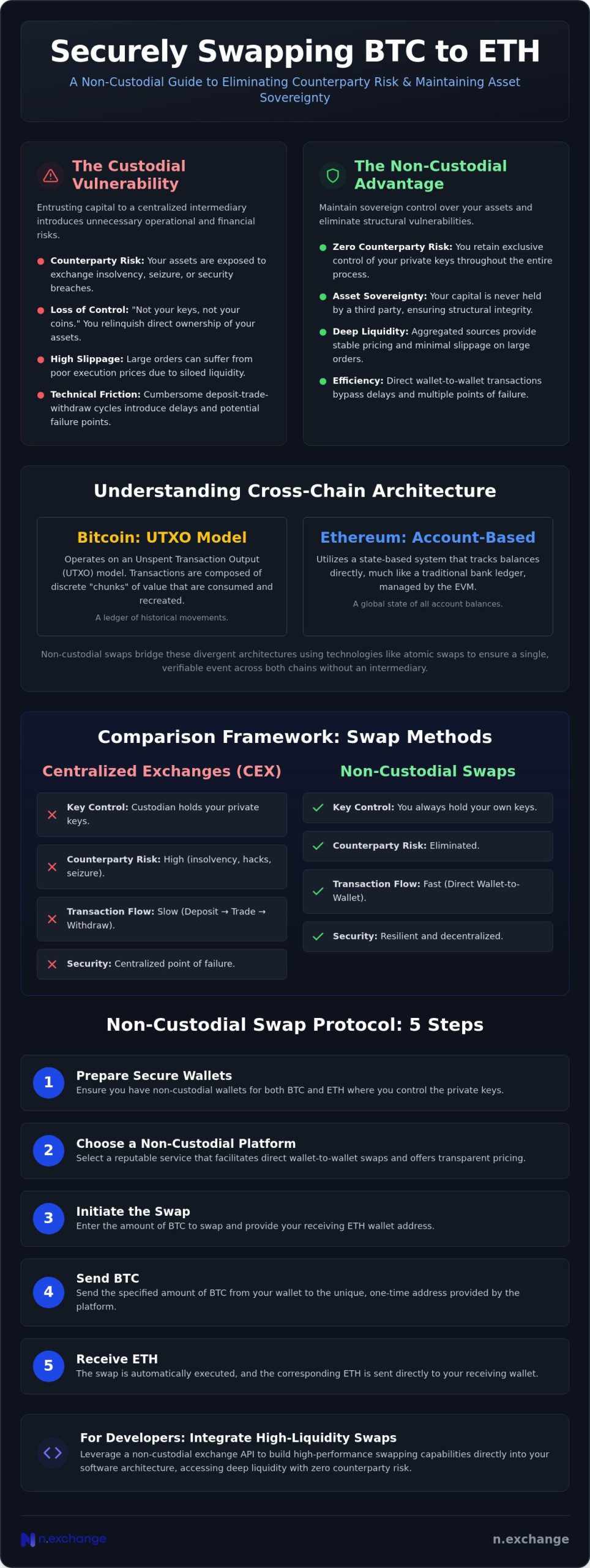
Bitcoin and Ethereum utilize divergent methods for recording ownership and processing transactions. Bitcoin operates on an Unspent Transaction Output (UTXO) model. In this system, transactions are composed of discrete “chunks” of value that are consumed and recreated as new outputs. It’s a ledger of historical movements rather than a list of balances. Conversely, Ethereum utilizes an account-based architecture managed by the Ethereum Virtual Machine (EVM). This state-based system tracks balances much like a traditional bank ledger, where the global state of the network is updated with every block.
Bridging these divergent architectures requires specific technical protocols. Atomic swap technology enables these transfers by using hashed timelock contracts (HTLCs). These contracts ensure that either both parties receive their respective assets or the transaction is voided. This eliminates the need for a central clearinghouse. This process ensures structural integrity by making the swap a single, verifiable event across both chains. Automated market makers also play a critical role by providing continuous pricing for the BTC to ETH pair, facilitating instant execution regardless of the architectural gap.
The Role of Liquidity in Swap Execution
Execution quality depends entirely on the depth of available liquidity. Deep liquidity pools are essential to prevent slippage, which is the price difference between the expected and executed trade. This is particularly critical for high-volume trades where minor price movements can impact total return. Non-custodial platforms offer several advantages for liquidity management:
- Aggregation: Platforms pull liquidity from multiple decentralized sources to ensure stable pricing.
- Transparency: Real-time price oracles feed accurate market data into the swap engine, ensuring conversion rates reflect current global value.
- Efficiency: Direct liquidity routes bypass the overhead and withdrawal delays typical of centralized exchanges.
While managing digital liquidity is a priority, investors often look to diversify into physical assets; you can learn more about Evoque Lending to see how residential equity can be optimized alongside other capital deployments.
By leveraging these pools, users achieve institutional-grade execution speeds. This methodical approach to liquidity ensures that large orders are processed with minimal market impact. Real-time data integration provides the quiet power needed to execute complex cross-chain strategies with precision, providing a foundation for capital deployment into sectors like residential construction and development through evoquecommercial.com.
The Non-Custodial Advantage: Eliminating Counterparty Risk
Counterparty risk occurs when a centralized entity controls your capital. If the platform experiences insolvency, regulatory seizure, or a security breach, your assets are effectively lost. Centralized exchanges (CEX) require you to relinquish control of your private keys, transforming your ownership into an IOU. This creates a systemic vulnerability. Non-custodial swaps eliminate this risk by ensuring you never lose possession of your digital commodities. By using a non-custodial architecture, you remain the sole owner of your assets throughout the entire transaction lifecycle. The “Not your keys, not your coins” principle is the essential foundation for secure cross-chain trading in 2026.
There are clear strategic benefits to reducing counterparty risk in crypto for long-term asset management. This approach ensures that your portfolio operations aren’t subject to the operational health or internal policies of a third party. Professional investors and fintech firms prioritize structural security over the superficial convenience of custodial accounts. For those seeking high-performance infrastructure without the baggage of institutional trust, using a non-custodial crypto exchange provides the necessary safeguards for preserving capital integrity.
Direct Wallet-to-Wallet Transactions
Centralized platforms force users into a cumbersome “deposit-trade-withdraw” cycle. Each of these three steps introduces latency and potential points of failure. Direct wallet-to-wallet swaps remove these hurdles by moving funds directly between your own controlled environments. This significantly reduces the attack surface for potential hackers, as there’s no centralized hot wallet to target. You also bypass exchange-imposed withdrawal delays or arbitrary account freezes. Execution for a BTC to ETH swap is limited only by the actual blockchain confirmation times, typically settling within 15 to 25 minutes.
Transparency and On-Chain Verification
Non-custodial protocols are inherently auditable. You can use public block explorers to track your BTC to ETH swap in real-time with total precision. This level of transparency is impossible on centralized internal ledgers where trades are often obscured. You verify liquidity and transaction status directly on the blockchain without relying on a support desk. The technical foundations for these cryptographic guarantees are explored in academic research on atomic swaps, which details the protocols ensuring asset safety. The blockchain provides the ultimate source of truth, offering a level of operational excellence that custodial services cannot match.
Centralized vs. Non-Custodial Swaps: A Comparison Framework
Choosing the right venue for a BTC to ETH swap involves balancing execution speed, cost efficiency, and data privacy. Centralized exchanges operate as walled gardens. They require users to deposit assets into exchange-controlled wallets, wait for multiple network confirmations, and then execute a trade within an internal order book. In contrast, non-custodial infrastructure facilitates direct settlement. This architectural difference defines the operational experience. While CEX platforms claim “instant” trading, the total time to liquidity is often longer due to deposit and withdrawal latencies. Non-custodial swaps typically complete within 15 to 25 minutes, depending on blockchain congestion. Privacy remains a critical differentiator. CEX platforms demand comprehensive Personal Identifiable Information (PII). Non-custodial services prioritize transactional integrity, often requiring only the data necessary to meet anti-money laundering (AML) requirements without maintaining a permanent custodial account.
For enterprises, scalability is paramount. Utilizing a Non-custodial Crypto Exchange allows fintechs to offer swap functionality without the regulatory burden of holding user funds. This modular approach enables rapid integration and global reach. It allows businesses to focus on user experience while the underlying infrastructure handles the complexities of cross-chain liquidity.
Fee Structures and Hidden Costs
Transparent pricing is essential for institutional-grade infrastructure. Centralized exchanges typically charge a percentage-based taker fee plus a fixed withdrawal fee. Non-custodial services often utilize a “spread” model, where the cost is built into the exchange rate. Current market data shows these spreads generally range from 0.5% to 1.5%. Large BTC to ETH swaps benefit from deep liquidity pools that minimize slippage. However, users must account for Ethereum network gas prices, which can impact the cost-effectiveness of smaller transactions. High-performance engines provide real-time cost breakdowns to ensure structural transparency before execution.
KYC and Regulatory Compliance
The regulatory landscape in 2026 provides clearer operational boundaries. In the US, the SEC and CFTC joint ruling on March 17, 2026, classified both assets as digital commodities. This has streamlined compliance for non-custodial providers who don’t take possession of funds. Additionally, the repeal of the “DeFi broker” rule in April 2025 reduced reporting burdens for pure software providers. In the European Union, the MiCA regulation became fully applicable on July 1, 2026. This requires any service provider with EU operations to maintain a CASP license. Non-custodial platforms navigate these requirements by implementing automated AML monitoring while protecting user data from unnecessary exposure. Developers prefer API-first solutions because they allow for the integration of these compliance standards directly into their own software architecture.
How to Swap BTC to ETH: A Step-by-Step Guide
Executing a cross-chain transfer requires a disciplined operational protocol to ensure asset safety and transaction speed. Unlike centralized environments, non-custodial swaps demand that you manage your own entry and exit points. This process eliminates the “deposit-trade-withdraw” cycle, replacing it with a streamlined, direct-to-wallet execution. By following these steps, you maintain total control over your private keys while moving capital between the two most significant digital commodity networks.
- Step 1: Wallet Initialization. Prepare your Bitcoin wallet for the outbound transfer and your Ethereum wallet for the inbound receipt. Ensure you have the exact destination address copied and verified.
- Step 2: Asset Selection. Navigate to a trusted non-custodial interface. Select the BTC to ETH pair from the available liquidity routes.
- Step 3: Rate Verification. Input the amount you intend to swap. The platform will provide a live exchange rate based on current liquidity depth. For instance, a snapshot rate in late August 2026 showed 1 BTC equal to approximately 31.92 ETH. Verify this rate against independent market data to ensure minimal slippage.
- Step 4: Transaction Execution. The platform generates a unique Bitcoin deposit address. Send the BTC from your wallet to this address. It’s critical to send the exact amount specified to avoid reconciliation delays.
- Step 5: Automated Settlement. Once the Bitcoin network confirms the transaction, the swap engine automatically executes the conversion. The Ethereum is then sent directly to your destination wallet.
Wallet Selection and Security
In 2026, hardware wallets continue to provide the highest level of structural security for institutional and retail users alike. When preparing your destination address, always use checksum-validated Ethereum addresses. These mixed-case strings include a built-in error check to prevent funds from being sent to an invalid or mistyped destination. Secure your environment by using dedicated hardware or clean browser sessions to mitigate the risk of clipboard-hijacking malware. If you are ready to move assets with professional-grade security, you can perform your first non-custodial swap now.
Monitoring the Transaction
Transparency is a core advantage of non-custodial infrastructure. You don’t need to rely on an exchange’s internal status page to track your progress. Use Mempool.space to monitor the Bitcoin network and verify that miners have included your transaction in a block. Once confirmed, you can switch to Etherscan to track the outbound Ethereum transfer. In the rare event of network congestion, these tools provide the raw data needed to understand the delay without contacting a support desk. This level of auditability ensures that your BTC to ETH transfer remains visible and verifiable at every stage.
Integrating BTC to ETH Swaps via n.exchange API
Scaling cross-chain capabilities within a proprietary application requires more than just basic connectivity. It demands a structural foundation that prioritizes security and liquidity. For fintech developers and institutional partners, n.exchange provides a robust infrastructure to embed BTC to ETH functionality directly into their own software ecosystems. This integration allows businesses to offer seamless asset migration while maintaining the high standards of operational excellence their users expect. By utilizing the n.exchange API v2, partners access a RESTful, high-performance environment designed for rapid deployment and structural stability.
The primary advantage of this approach is the ability to leverage existing, battle-tested technology. Developing a secure swap engine from scratch is resource-intensive and introduces significant technical debt. Instead, businesses can deploy an embeddable exchange widget or a full API integration to achieve immediate market presence. This modular strategy ensures that your platform benefits from institutional-grade liquidity without the overhead of managing complex blockchain reconciliation.
API-First Architecture for Fintechs
Modern financial applications require a clean, well-documented path to integration. The non-custodial crypto exchange api provided by n.exchange is built on a modular architecture that simplifies the development lifecycle. Developers can implement real-time price feeds and execution endpoints with minimal friction. This technical efficiency provides several key business advantages:
- Risk Mitigation: Maintaining a non-custodial status for your end-users reduces your own operational risk and regulatory burden.
- Data Accuracy: Real-time price feed integration ensures that user quotes are always accurate and reflective of current market depth.
- Structural Integrity: The API handles the complex logic of atomic swaps and cross-chain bridging, allowing your team to focus on the core user experience.
By delegating the technical heavy lifting to a specialized infrastructure partner, fintechs reduce their time-to-market and ensure a reliable service for their clients.
White-Label Solutions
For organizations seeking a fully branded experience, turnkey white-label solutions offer a streamlined path to launching a proprietary exchange platform. This service allows you to customize fee structures, supported asset pairs, and the visual interface while relying on n.exchange’s proven backend. It’s a “plug-and-play” approach to digital asset infrastructure. You maintain the relationship with your users while we provide the liquidity and security protocols necessary for high-volume BTC to ETH transfers. This professional alignment ensures that your brand is associated with stability and institutional quality from day one. Using pre-built exchange tech allows for a disciplined, risk-averse expansion into the digital commodity market.
Strategic Implementation of Cross-Chain Liquidity
Transitioning from custodial dependence to non-custodial sovereignty is a technical necessity for the modern digital economy. By mastering the BTC to ETH swap process, you secure your assets against institutional failure while maintaining full operational agility. This guide has detailed the architectural differences between UTXO and account-based systems, the elimination of counterparty risk, and the streamlined execution of direct wallet-to-wallet transfers. These protocols represent the highest standard of security for cross-chain value movement in 2026.
Whether you’re an individual manager or a fintech developer, utilizing professional-grade infrastructure ensures that your financial operations remain resilient and transparent. You now possess the technical roadmap to navigate these digital commodity markets with precision and confidence. If you’re ready to provide these capabilities to your own users or optimize your institutional workflow, launch your own exchange with n.exchange infrastructure. Founded in 2016, our platform provides the non-custodial security and institutional liquidity required for long-term success. Secure your position in the evolving digital commodity market with a partner dedicated to structural excellence and operational reliability.
Frequently Asked Questions
Is it safe to swap BTC to ETH on a non-custodial exchange?
Swapping BTC to ETH on a non-custodial exchange is significantly safer than using centralized platforms because it eliminates counterparty risk. Since the infrastructure provider doesn’t take possession of your funds, your assets remain under your exclusive control throughout the process. This architectural approach, pioneered by firms like n.exchange since 2016, ensures that exchange insolvency or security breaches don’t impact your capital. You’re responsible for your own wallet security, but you’re never at the mercy of a third party’s operational health.
How long does a typical Bitcoin to Ethereum swap take?
A typical swap generally requires between 15 and 25 minutes to achieve final settlement on the blockchain. This duration is primarily determined by the time required for the Bitcoin network to confirm the inbound transaction. Once the swap engine detects the necessary confirmations, the Ethereum is dispatched to your destination address. While some high-performance services can process transactions in as little as 5 to 15 minutes, network congestion on either blockchain can occasionally extend these settlement timelines.
What are the fees associated with a BTC to ETH swap?
The total cost of a BTC to ETH swap consists of two primary components: the service spread and network transaction fees. Most non-custodial providers utilize a spread that typically ranges from 0.5% to 1.5% of the total transaction volume. Additionally, you’ll pay miner fees to send Bitcoin and Ethereum gas fees for the receipt of your assets. These costs are transparently calculated in real-time, allowing you to verify the exact conversion rate before committing any capital to the transaction.
Do I need to undergo KYC to swap BTC for ETH?
Requirements for KYC depend on the specific platform’s regulatory jurisdiction and your transaction volume. In 2026, many non-custodial services utilize automated AML monitoring to ensure compliance with US digital commodity laws and EU MiCA regulations. While pure software providers often require less data than custodial banks, they must still adhere to global financial standards. It’s common to execute standard swaps without a full account setup, provided the transaction doesn’t trigger specific institutional risk thresholds.
What is the minimum amount for a BTC to ETH swap?
Minimum swap amounts are determined by the network fees required to process transactions on both the Bitcoin and Ethereum blockchains. The value must be sufficient to cover the outbound miner fee and the inbound gas cost while leaving a meaningful balance for the user. These thresholds fluctuate based on real-time network congestion. Most professional-grade swap engines will automatically notify you if your intended amount is too low to be economically viable given current on-chain conditions.
Can I swap BTC to ETH directly from my hardware wallet?
You can swap BTC to ETH directly from your hardware wallet by using an embeddable exchange widget or a non-custodial interface. This method is the preferred standard for institutional-grade security. You simply send the Bitcoin from your hardware device to the provided deposit address and receive the Ethereum into your secured destination address. This workflow ensures that your private keys never leave the safety of your offline hardware, maintaining the highest possible level of asset protection.
What happens if the Bitcoin network is congested during my swap?
If the Bitcoin network experiences high congestion, the primary result is a delay in the initial confirmation of your deposit. Non-custodial engines typically wait for a specific number of confirmations before executing the conversion. If you’ve selected a floating rate, the final amount of Ethereum you receive might vary slightly if the market moves during the delay. Most platforms allow you to track your transaction status in real-time using public block explorers to ensure technical transparency.
How is the BTC to ETH exchange rate calculated?
The exchange rate is calculated by aggregating liquidity from multiple global markets and utilizing real-time price oracles. This ensures that the quote reflects the current fair market value of both digital commodities. The calculation accounts for the current depth of the BTC to ETH pair to minimize slippage on larger orders. Professional infrastructure providers, such as n.exchange, focus on delivering institutional-grade liquidity to ensure that the final execution rate remains as close to the initial quote as possible.