
Centralized liquidity for privacy assets has effectively vanished under the weight of 2026 regulatory mandates. As major exchanges delist Monero to comply with MiCA and FATF requirements, the burden of secure execution has shifted to the user. Executing a BTC to XMR swap today requires more than a simple interface; it demands a robust, non-custodial infrastructure that bypasses the inherent vulnerabilities of custodial platforms. You likely recognize that institutional-grade privacy shouldn’t force a trade-off with security or operational efficiency.
We’ll demonstrate how to master these conversions using high-liquidity, non-custodial frameworks designed for stability. This guide provides a comprehensive technical path to secure asset delivery while eliminating the counterparty risks associated with platform insolvency. You’ll learn to integrate automated exchange workflows, manage slippage on large orders, and verify private asset delivery through a disciplined, architectural approach to decentralized finance.
Key Takeaways
- Understand why non-custodial architecture is the only secure bridge for executing a BTC to XMR swap in the current regulatory landscape.
- Master the technical requirements for Monero recipient wallets and manage mempool dynamics to ensure optimal execution speed.
- Eliminate counterparty risk by utilizing infrastructure that never holds user funds, protecting your assets from platform insolvency.
- Deploy institutional-grade APIs and embeddable widgets to automate swap workflows within your own fintech ecosystem.
- Verify the successful delivery of private assets through a disciplined, step-by-step verification process designed for high-liquidity transfers.
The Strategic Importance of BTC to XMR Swaps
Strategic asset allocation in 2026 requires a sophisticated understanding of the BTC/XMR pair. While Bitcoin serves as the primary reservoir of global crypto liquidity, Monero provides the necessary obfuscation for sensitive financial operations. This pair bridges the gap between public ledger transparency and private wealth management. For institutional entities and high-net-worth individuals, the ability to execute a BTC to XMR swap isn’t merely a technical preference; it’s a fundamental requirement for maintaining operational security in an era of total blockchain transparency.
Bitcoin Liquidity vs. Monero Privacy
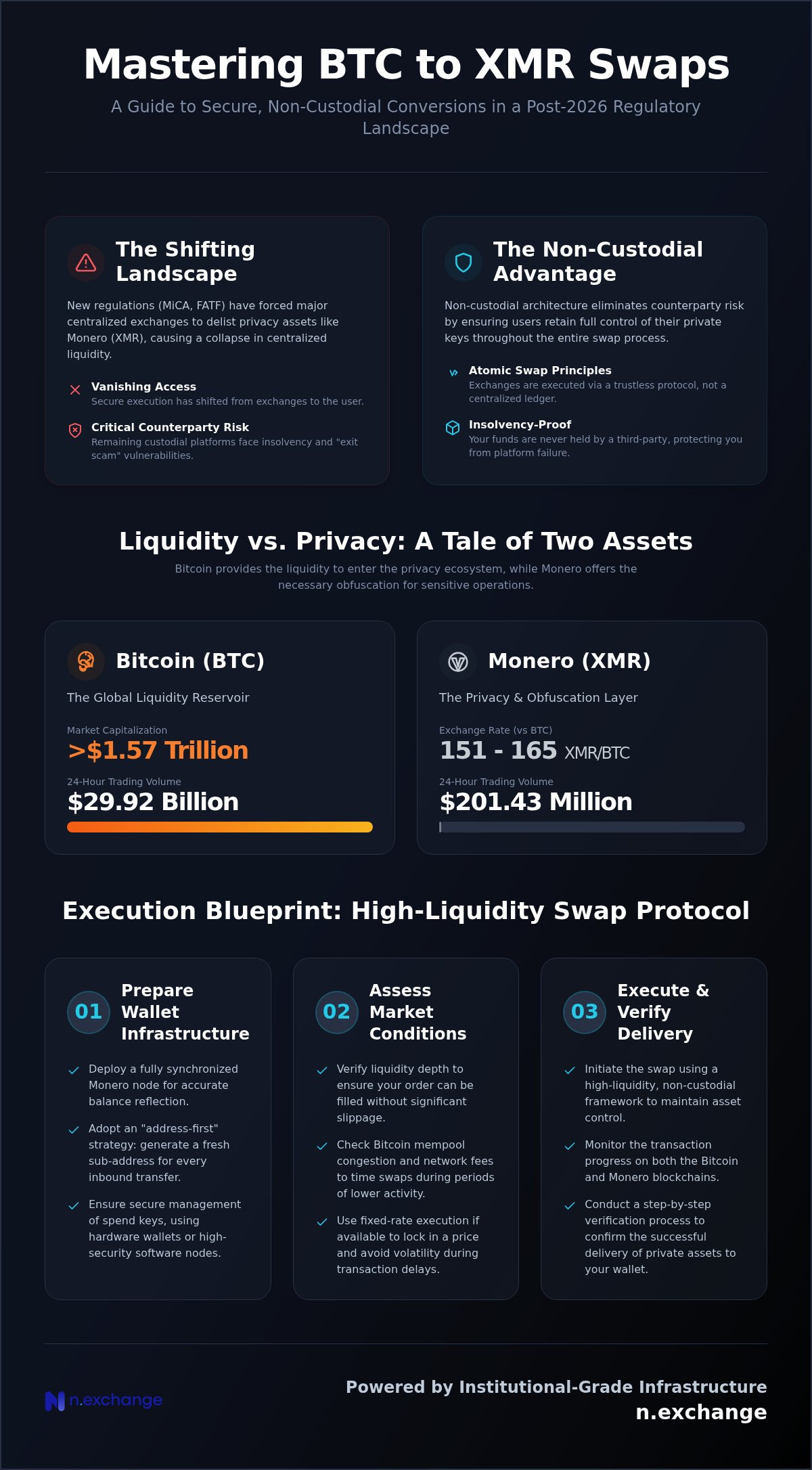
Bitcoin remains the most efficient gateway for entering the privacy ecosystem. With a market capitalization exceeding $1.57 trillion, BTC offers the depth required to absorb large orders without catastrophic slippage. In contrast, Monero’s focused liquidity is optimized for privacy rather than high-volume entry. The technical friction involved in moving between these two distinct blockchain architectures can be significant. However, the BTC/XMR bridge is a critical tool for financial sovereignty. By converting transparent BTC into obfuscated XMR, users can shield their transaction history from unauthorized surveillance while benefiting from the price discovery of the broader market.
Non-Custodial Advantage in 2026
The regulatory environment of 2026 has fundamentally altered the exchange landscape. Centralized platforms have largely delisted privacy assets to comply with the FATF Travel Rule and MiCA frameworks. This shift has elevated the risk of platform insolvency or “exit scams” for users who rely on the few remaining centralized privacy exchanges. Non-custodial architecture solves this by eliminating counterparty risk entirely. Users maintain control of their private keys throughout the entire conversion process, ensuring that funds are never held by a third party.
This approach utilizes principles similar to atomic swap technology, where the exchange is executed through a trustless protocol rather than a centralized ledger. For modern fintechs, there are also clear compliance benefits of non-custodial exchange systems. By avoiding the custody of user assets, these platforms reduce their regulatory surface area while providing a more secure service. Non-custodial execution ensures that a BTC to XMR swap remains a private, secure, and verifiable event, free from the systemic risks of centralized custodianship.
Preparing for High-Liquidity Non-Custodial Swaps
Successful execution of a BTC to XMR swap begins with rigorous technical preparation. In a professional setting, this means moving beyond consumer-grade tools toward institutional-grade infrastructure. The focus must remain on asset segregation and total control over private keys. This alignment with established Consumer Protection Guidance ensures that you eliminate the systemic risks inherent in custodial systems while maintaining operational excellence.
Monero Wallet Infrastructure
Professional Monero management requires a synchronized node and a secure environment for your spend keys. While hardware wallets provide robust cold storage, institutional workflows often utilize high-security software nodes for faster transaction signing. You should adopt an “address-first” strategy. This means generating a fresh sub-address for every inbound transfer before you even initiate the swap. It’s also vital to ensure your Monero node is fully synced. If your daemon isn’t current, you won’t see your funds arrive, which can cause unnecessary operational friction during high-value transfers.
Assessing Market Conditions
Liquidity depth is the most critical variable when moving large volumes of Bitcoin. With Bitcoin’s 24-hour trading volume near $29.92 billion and Monero’s at approximately $201.43 million, the disparity in depth can lead to slippage if not managed correctly. As of September 2026, the exchange rate for a BTC to XMR conversion typically fluctuates between 151.02 XMR and 165.15 XMR per Bitcoin. You must verify that your chosen infrastructure partner can access enough liquidity to fill your order within these tight spreads.
Mempool congestion also plays a role in timing. High network traffic on the Bitcoin blockchain can delay the initial deposit, potentially affecting the final rate if you aren’t using a fixed-rate execution. Professionals should check current network fees and mempool depth to time their swaps during periods of lower activity. For those requiring a streamlined, professional-grade crypto swap, utilizing a reliable infrastructure partner is essential.
Finally, manage your keys with discipline. In a professional environment, spend keys should be restricted to authorized signing devices. View keys can be used more broadly for auditing purposes without compromising the security of the underlying assets. This separation of concerns is the hallmark of a secure, technical approach to privacy asset management.
Step-by-Step: Swapping Bitcoin for Monero via n.exchange
Executing a high-liquidity swap requires a methodical approach to ensure both accuracy and security. The n.exchange platform is engineered to facilitate these transfers without the need for custodial accounts, ensuring that you remain the sole arbiter of your funds. By following a structured protocol, you’ll complete a BTC to XMR conversion with the precision required for professional financial operations.
Inputting Transaction Parameters
The process begins by defining the scope of your transfer. On the primary interface, you’ll select Bitcoin (BTC) as the input currency and Monero (XMR) as the output. Enter the specific amount of BTC you intend to convert. The system provides a real-time quote based on current market depth and the prevailing exchange rate, which in late 2026 remains highly dynamic. You’ll need to decide between two primary execution models:
- Fixed Rate: This locks in the exchange rate for a set window, protecting the transaction from volatility during the Bitcoin confirmation period.
- Floating Rate: The final amount of XMR received is determined by the market price at the moment the Bitcoin deposit is confirmed.
Verification of the recipient Monero address is the most critical step in this phase. Because Monero utilizes stealth addresses and ring signatures, transactions are irreversible. You should always use a fresh sub-address generated by your synchronized node. Double-check every character of the string to prevent the permanent loss of assets.
Finalizing the Non-Custodial Transfer
Once you’ve confirmed the parameters, the platform generates a unique, one-time deposit address for your Bitcoin. You must send the exact amount specified in the order to this address. It’s best practice to use a wallet that allows for manual fee adjustment to ensure your transaction is picked up in the next block. Delayed deposits can lead to order expiration or rate shifts in floating-rate swaps.
The n.exchange engine monitors the Bitcoin blockchain in real-time. Once the required network confirmation thresholds are met, the system automatically triggers the release of Monero to your designated wallet. This automation is handled via secure smart-routing logic that settles the trade across liquidity pools without ever taking custody of your private keys. You can track the progress of the BTC to XMR swap through a transparent status dashboard, which provides transaction hashes for both the inbound and outbound legs of the transfer. This level of transparency ensures that you can audit the delivery of private assets with institutional-grade certainty.
Eliminating Counterparty Risk in Privacy Asset Transfers
Custodial exchanges represent a structural vulnerability in the privacy asset sector. By requiring users to deposit funds into a platform-controlled wallet, these entities create a massive honeypot for attackers and a point of seizure for regulators. When you utilize a custodial service for a BTC to XMR conversion, you aren’t trading assets; you’re trading for an IOU on a private ledger. If that platform faces insolvency or a security breach, your claim to those assets evaporates instantly. This counterparty risk is entirely avoidable through the adoption of non-custodial architecture.
Security Architecture Deep Dive
Non-custodial systems replace trust with verifiable direct settlement. In this model, the exchange infrastructure acts as a secure router rather than a vault. API-first exchanges like n.exchange utilize decentralized liquidity to ensure that every swap is backed by verifiable on-chain assets rather than internal ledger entries. By 2026, institutional security standards have shifted decisively toward this architecture. It’s no longer acceptable to expose private wealth to the operational risks of a third-party custodian. Direct settlement ensures that the transition from a transparent Bitcoin ledger to an obfuscated Monero ledger happens without intermediate holding periods, maintaining the integrity of the swap from initiation to completion.
Risk Management for Large Swaps
Executing high-volume orders requires a strategy that minimizes market impact. Ultra-large BTC to XMR orders should be broken down into smaller, staggered tranches. This prevents significant price slippage and avoids triggering automated liquidity throttles within the pools. Non-custodial infrastructure partners provide the high-liquidity depth necessary to absorb these tranches efficiently. This approach also mitigates the risk associated with “tainted” Bitcoin. Because the swap is transactional and ephemeral, you avoid the long-term account freezes common on centralized exchanges that flag assets based on historical chain analysis.
Transparency in execution is non-negotiable. You must have access to real-time execution logs and transaction hashes for both chains. Verifying the integrity of the Monero delivery involves checking the transaction hash on a block explorer to confirm the funds have reached the stealth address. This disciplined verification process provides the final layer of assurance for your private asset portfolio. For organizations ready to implement these secure protocols, you can start your non-custodial crypto swap today to secure your financial privacy.
Implementing BTC to XMR Swaps for Fintech Platforms
Modern fintech platforms require more than manual interfaces. They need programmatic access to privacy asset liquidity to remain competitive in a landscape that increasingly values financial discretion. Integrating a BTC to XMR bridge directly into a wallet or dashboard enhances user retention and provides a significant value-add for privacy-conscious clients. By utilizing non-custodial infrastructure, platforms can offer these swaps without the regulatory burden and security risks associated with holding customer funds.
API Integration for Developers
The n.exchange API provides a robust framework for automated cross-chain settlement. Developers can access real-time BTC/XMR price feeds and execution endpoints through a RESTful interface. This allows for the creation of sophisticated trading bots, internal treasury management tools, or automated rebalancing scripts. Security remains paramount in these environments. API keys should be managed within secure environment variables and restricted by IP to prevent unauthorized access. For detailed technical specifications, refer to this guide to non-custodial crypto APIs for fintechs. This documentation outlines the precise request-response cycles and authentication protocols necessary for a stable, high-performance integration.
The White-Label Solution for Privacy Assets
Organizations seeking to launch their own branded exchange can leverage a White Label Exchange Solution to bypass months of development time. This path allows businesses to deploy a fully functional BTC to XMR swap service in days. You maintain complete control over the brand identity while utilizing n.exchange’s proven liquidity engine to handle the underlying execution. The Embeddable Exchange Widget offers a modular alternative for existing applications. It provides a frictionless user experience for customers seeking Monero access without requiring them to leave your primary dashboard.
Scaling this infrastructure requires a partner capable of handling high-frequency asset movements. High-liquidity pools ensure that even during periods of market stress, your platform’s execution remains consistent. This modular approach to infrastructure allows fintechs to focus on user acquisition and frontend experience while the underlying engine handles the complexities of cross-chain settlement. It’s a disciplined path toward offering institutional-grade privacy services with minimal operational overhead.
Securing Your Privacy Infrastructure
The transition toward privacy-centric asset management requires a disciplined commitment to security architecture. Non-custodial execution has emerged as the definitive standard for preserving capital during a BTC to XMR conversion. By eliminating the structural vulnerabilities of centralized custodians, you ensure that your assets remain under your direct control throughout the entire lifecycle of the swap. This approach doesn’t just protect against platform insolvency; it provides the technical foundation for institutional-grade financial sovereignty.
Professional entities must prioritize infrastructure that offers both depth and reliability. Utilizing high-liquidity pools and robust API integrations allows for seamless, automated workflows that scale with your operational needs. Since 2016, n.exchange has provided the stable, non-custodial framework required for these complex cross-chain movements. You can execute your secure BTC to XMR swap on n.exchange today to benefit from a proven track record of secure execution and institutional-grade liquidity. Protecting your privacy is a technical challenge that has a clear, professional solution.
Frequently Asked Questions
Is it possible to swap BTC to XMR without a centralized exchange?
Yes, non-custodial platforms like n.exchange facilitate these swaps through decentralized liquidity infrastructure. This architecture allows for direct asset exchange without requiring a third party to hold user funds. It’s the primary method for privacy asset management in 2026 due to the widespread delisting of Monero on centralized platforms. Users maintain full control of their private keys throughout the entire transaction lifecycle.
How long does a non-custodial Bitcoin to Monero swap typically take in 2026?
The duration is primarily determined by network confirmation times on the Bitcoin blockchain. Typically, a swap is processed once the BTC deposit reaches the required confirmation threshold, which usually takes between 10 and 30 minutes. Once confirmed, the n.exchange engine automates the release of Monero. High mempool congestion on the Bitcoin network can extend this timeframe, so using appropriate network fees is recommended for faster execution.
What are the fees associated with swapping BTC for XMR on n.exchange?
Fees for a BTC to XMR swap are integrated into the exchange rate provided at the time of the transaction. These costs include the service fee for utilizing the non-custodial infrastructure and the necessary network fees for broadcasting transactions on both the Bitcoin and Monero blockchains. The platform prioritizes transparency by showing the final amount of XMR you’ll receive before you initiate the transfer, ensuring there are no hidden charges during settlement.
Can I use the n.exchange API to automate BTC to XMR swaps for my application?
Developers can utilize the robust n.exchange API to integrate automated swap functionality directly into their fintech applications or wallets. The API provides endpoints for real-time price quotes, order creation, and transaction monitoring. This infrastructure allows businesses to offer non-custodial exchange services to their users while leveraging a proven liquidity engine. It’s an efficient solution for platforms that require high-frequency, cross-chain asset movements without the burden of custodial management.
Why is Monero often swapped from Bitcoin instead of purchased directly with fiat?
Regulatory frameworks in 2026 have made direct fiat-to-XMR purchases difficult on most regulated platforms. Bitcoin serves as a highly liquid entry point that can be easily acquired through various channels. By swapping BTC for XMR, users can transition from a transparent ledger to a private one. This process bridges global liquidity with the specific privacy features of the Monero network, such as ring signatures and stealth addresses.
Is the BTC to XMR exchange rate fixed or floating during the swap?
The platform offers both fixed and floating rate options to suit different risk profiles. A fixed rate locks in the quote for a specific window, protecting the transaction from market volatility while the Bitcoin deposit confirms. A floating rate adjusts based on the market price at the exact moment of confirmation. Choosing the right model depends on current market conditions and the user’s requirement for price certainty during the execution period.
What happens if I send the wrong amount of Bitcoin to the swap address?
If the amount sent doesn’t match the order parameters, the system will typically flag the transaction for manual review or automatic adjustment. In most cases, the exchange engine will recalculate the output based on the actual amount received, provided it meets the minimum threshold. If the amount is significantly different or below the limit, the funds may be returned to the originating address after deducting network fees. Accuracy is critical for seamless non-custodial execution.
Are there limits on how much Monero I can receive in a single non-custodial swap?
Limits are determined by the available liquidity depth in the XMR pools at the time of the request. The infrastructure is designed to handle institutional-grade volumes, allowing for substantial transfers. For ultra-large orders, it’s often more efficient to execute the swap in tranches to minimize market impact and ensure the best possible exchange rate. The platform provides real-time feedback on maximum trade sizes within the exchange interface or through the API.