
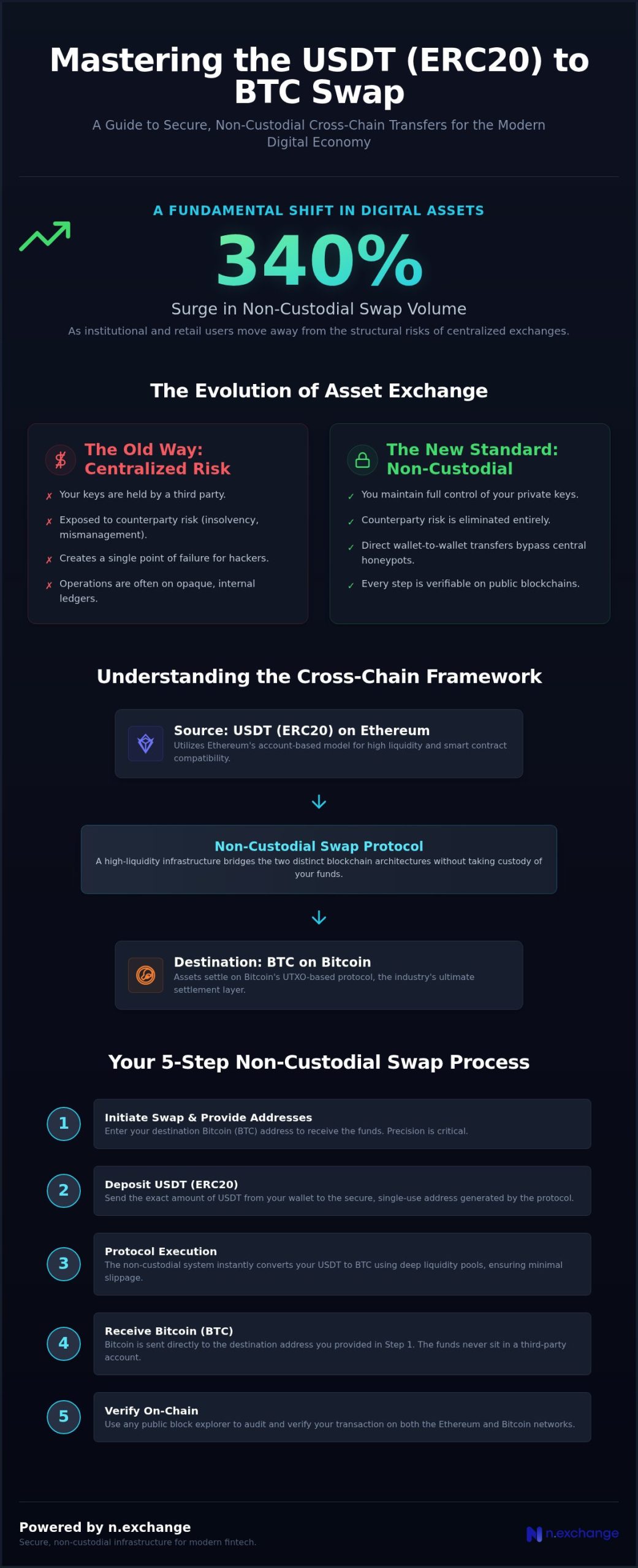
Non-custodial swap volumes have surged by 340% as institutional and retail participants move away from the structural risks of centralized exchanges. This shift underscores a fundamental transition in how digital assets move between networks. You likely understand that executing a USDT (ERC20) to BTC swap involves more than just a simple trade. It’s a cross-ecosystem bridge that often comes with the baggage of Ethereum gas fees and the persistent threat of counterparty risk. Relying on a third party to hold your keys during the transition is no longer a standard many are willing to accept.
This guide will help you master the technical process of swapping Ethereum-based USDT for Bitcoin using secure, non-custodial architecture. You’ll learn to maintain full control of your private keys while achieving minimal slippage and rapid execution. We’ll detail the exact steps to initiate the swap, manage potential network congestion, and verify your transaction on both the Ethereum and Bitcoin explorers. By prioritizing structural integrity and transparency, you can ensure your cross-chain operations remain efficient and secure.
Key Takeaways
- Understand the technical architecture required to bridge Ethereum-based assets to the Bitcoin network securely.
- Remove counterparty risk entirely by adopting non-custodial protocols that ensure you never relinquish control of your funds.
- Optimize the cost of your USDT (ERC20) to BTC swap by evaluating Ethereum gas consumption and selecting the most efficient rate model.
- Follow a structured, step-by-step implementation guide to ensure precision in wallet address entry and transaction verification.
- Scale operations by leveraging institutional exchange APIs and white-label widgets designed for seamless fintech integration.
Understanding the USDT (ERC20) to BTC Exchange Framework
A USDT (ERC20) to BTC swap represents a sophisticated cross-chain liquidity event. It requires the seamless transfer of value from the Ethereum Virtual Machine (EVM) environment to the Bitcoin protocol. These two networks utilize fundamentally different architectures. Ethereum operates on an account-based model, while Bitcoin relies on Unspent Transaction Outputs (UTXO). Bridging this gap requires high-liquidity infrastructure that can execute the conversion without exposing the participant to the risks associated with centralized custody.
Liquidity providers play a critical role in this framework. They ensure that deep pools of assets are available on both networks to facilitate direct conversion. Without this depth, large swaps would suffer from significant slippage, eroding the value of the transaction. For institutional partners, non-custodial architecture is the only viable path. It eliminates the counterparty risk inherent in centralized exchanges, where funds are held in a third-party wallet during the process.
The Role of ERC20 in the Tether Ecosystem
The ERC20 standard is a technical protocol for smart contracts on the Ethereum blockchain. It provides a standardized set of rules that allow Tether (USDT) to interact with a vast array of decentralized applications and professional wallets. While Tether is issued on multiple blockchains, the Ethereum-based version remains the benchmark for institutional liquidity. Most high-value settlements occur on Ethereum because of its proven security track record and its central role in global digital asset markets. Choosing the ERC20 standard ensures that your stablecoin assets remain highly liquid and compatible with professional-grade infrastructure.
Bitcoin as the Target Asset
Bitcoin serves as the ultimate settlement layer for the digital asset industry. Its UTXO model provides a transparent and immutable history of every transaction, offering a different security profile than Ethereum’s account-based system. When you execute a USDT (ERC20) to BTC swap, you are moving from a price-stable asset into a deflationary store of value. This transition is a core strategy for digital asset management, allowing firms to lock in gains or rebalance portfolios into the market’s most liquid asset. Bitcoin transactions offer definitive finality. This makes it the preferred destination for long-term capital preservation.
Why Non-Custodial Swaps are Essential in 2026
The landscape of digital asset exchange has fundamentally shifted. In 2026, non-custodial swap volumes have increased by 340%. This growth reflects a broader institutional realization: centralizing assets during a USDT (ERC20) to BTC conversion introduces unnecessary vulnerability. By removing the central intermediary, participants eliminate the risk of exchange insolvency or internal mismanagement. The ‘not your keys, not your coins’ principle is now a mandatory operational standard for high-value transactions. This approach ensures that ownership remains with the user at every stage of the process.
Adopting this model provides significant benefits of non-custodial architecture for fintech platforms. It minimizes regulatory friction while maximizing security. As U.S. stablecoin regulations evolve, particularly following the 2025 implementation of the GENIUS Act, the demand for transparent, on-chain settlement has increased. Non-custodial frameworks provide the structural integrity required to meet these modern compliance and security benchmarks.
Reducing Counterparty Risk
Centralized exchanges (CEXs) create single points of failure. They aggregate massive quantities of user capital in hot wallets, making them primary targets for exploitation. A non-custodial USDT (ERC20) to BTC swap bypasses this risk through direct wallet-to-wallet delivery. Assets move directly from the source Ethereum wallet to the destination Bitcoin address once the protocol confirms the deposit. This mechanism aligns with the reducing counterparty risk in crypto framework, which prioritizes structural isolation over trusted third parties. It’s a cleaner, more resilient method for moving value across chains.
Operational Security Standards
Institutional partners require more than just security; they require verifiable transparency. On-chain verification allows every participant to audit the transaction flow in real-time. This level of visibility is impossible within the opaque ledgers of a centralized provider. For developers and businesses, integrating a non-custodial crypto exchange api provides a streamlined path to offering these benefits to end-users. This API-first approach ensures that platforms can scale without increasing their custodial liability. If you’re building a finance application, consider how a non-custodial crypto swap integration can simplify this process while maintaining your users’ security.
Evaluating Rates and Network Fees for USDT (ERC20)
Executing a USDT (ERC20) to BTC swap requires a dual-layered cost analysis. You must account for the smart contract execution costs on Ethereum and the conversion rate volatility between the stablecoin and Bitcoin. In 2026, network efficiency has improved significantly, but precise calculation remains vital for institutional capital preservation. Every basis point matters when moving high-value assets across chains.
Network congestion directly dictates execution speed. While modern infrastructure has narrowed the performance gap, high demand on the Ethereum mainnet can still delay the initial outbound transfer of USDT. Optimization strategies focus on liquidity routing and timing. By understanding the underlying fee structures, participants can ensure their swaps are both fast and cost-effective.
Fixed vs. Floating Swap Rates
Choosing the correct rate model depends on your risk tolerance and market conditions. Fixed rates provide a guaranteed execution price. This model is ideal when Bitcoin volatility is high, as it protects the participant from slippage during the confirmation window. You receive exactly what you see at the start of the transaction. It’s a matter of certainty.
Floating rates track the market in real-time. This typically results in lower spreads and is the preferred choice for those prioritizing long-term cost efficiency over immediate price certainty. Liquidity depth is the primary driver here. Non-custodial models with high-liquidity, API-first architectures ensure that even high-volume swaps execute with minimal price impact. Deep pools mean tighter spreads.
Managing Ethereum Network Gas
As of September 12, 2026, the average Ethereum transaction fee is approximately $0.2515. A standard ERC20 token transfer typically consumes around 65,000 gas. These figures represent a significant reduction from previous years, largely due to the widespread adoption of Layer 2 scaling solutions. However, mainnet swaps still require careful management of gas limits to avoid failed transactions.
Timing your USDT (ERC20) to BTC swap can further reduce overhead. Monitoring the network for low-congestion periods ensures the outbound USDT transfer is processed at the lowest possible cost. The technical reality of cross-chain bridge fees in 2026 is one of transparency and efficiency. Infrastructure providers have optimized routing to ensure that the total cost of a non-custodial swap remains competitive with centralized alternatives while maintaining superior security standards.
Step-by-Step Guide: How to Swap USDT (ERC20) for BTC
Precision is the primary requirement for successful cross-chain liquidity transfers. The technical process of executing a USDT (ERC20) to BTC swap involves a series of coordinated steps between the Ethereum and Bitcoin protocols. It begins with the selection of the specific asset pair within the exchange interface. This selection dictates the underlying routing and liquidity pools used for the conversion. Errors at this stage can lead to failed transactions or unnecessary fees, so verifying the network selection is essential.
Once the pair is established, the participant must enter the destination Bitcoin wallet address. This step represents the most critical juncture in the swap. Unlike centralized environments, non-custodial swaps offer no “undo” function; once the assets are moved, the transaction is immutable. Following the entry, the user initiates an outbound USDT transfer from their personal Ethereum wallet to the deposit address generated by the exchange architecture. Monitoring this process through external blockchain explorers ensures total transparency from start to finish.
Preparation and Wallet Configuration
Before initiating the swap, verify that your source Ethereum wallet contains sufficient ETH to cover gas fees. As established, a standard ERC20 transfer consumes approximately 65,000 gas; without this overhead, the transaction will stall. Simultaneously, you must confirm the format of your recipient Bitcoin address. Most modern platforms support SegWit (Bech32) addresses for lower fees and faster confirmation, but ensuring compatibility with your specific wallet provider is vital. Address verification should be performed using a “copy-paste” method followed by a manual visual check of the first and last four characters. This redundancy mitigates the risk of clipboard hijacking or manual entry errors.
Execution and Confirmation
After confirming the exchange rate and the transaction timeout period, you can proceed with the deposit. The n.exchange widget provides real-time status updates, moving from “awaiting deposit” to “exchanging” and finally “settled.” To maintain an independent audit trail, use Etherscan to track the outbound USDT (ERC20) transaction. Once the Ethereum network confirms the transfer, switch to Mempool.space to monitor the Bitcoin network’s progress. You’ll see the incoming BTC transaction appear as “unconfirmed” before it reaches the required number of network confirmations for finality. This dual-explorer approach provides definitive proof of settlement.
To begin your transaction with institutional-grade security, access our non-custodial USDT (ERC20) to BTC exchange interface and follow these protocols for a seamless experience.
Institutional Swap Infrastructure for Modern Fintech
Modern fintech platforms require more than just a retail interface; they need robust, scalable infrastructure. Leveraging a non-custodial Exchange API allows for the automation of high-volume USDT (ERC20) to BTC swaps without the operational overhead of managing private keys. This structural choice reduces the regulatory burden for US-based startups by ensuring they never touch user funds. By acting as a technology provider rather than a money transmitter, businesses can maintain a leaner compliance profile while offering sophisticated financial services.
For firms looking to deploy rapidly, customizing a turnkey crypto exchange solution provides a significant competitive edge. It allows brands to offer institutional-grade swaps under their own identity while relying on proven, high-liquidity architecture. This approach ensures operational excellence from day one, allowing the business to focus on user acquisition rather than the complexities of cross-chain settlement. Reliability is the cornerstone of institutional adoption.
Developer-First Integration
Engineering teams can accelerate deployment by consulting the developer documentation for a crypto api. The embeddable exchange widget serves as a frictionless entry point for adding swap features to existing web applications with minimal code. By utilizing an API-first approach, developers can implement USDT (ERC20) to BTC functionality without building a proprietary settlement engine. Implementing high-liquidity swaps without the burden of fund management is a strategic necessity. This isolation of the swap logic from the core platform ensures superior security and performance while reducing the attack surface for the parent application.
White-Label Strategic Advantages
Scalability is the primary driver behind evaluating white label exchange providers. Building a cross-chain bridge from scratch is resource-intensive and carries high technical risk. Utilizing a white-label exchange solution allows fintechs to scale their crypto offering using non-custodial infrastructure that has already been battle-tested. In the 2026 landscape, success depends on the ability to bridge assets like USDT and BTC with zero friction. The future of cross-chain interoperability relies on these modular, non-custodial frameworks that prioritize user control and structural transparency. This model provides the necessary foundation for long-term growth in a rapidly evolving digital asset market.
Securing the Future of Cross-Chain Settlement
Transitioning from stablecoins to Bitcoin requires a focus on structural integrity and the total elimination of counterparty risk. By prioritizing non-custodial architecture, you ensure that every USDT (ERC20) to BTC swap maintains the highest standards of security and transparency. Success in this landscape depends on your ability to manage technical details like Ethereum gas fees and precise address verification while leveraging high-liquidity routing. It’s no longer enough to rely on centralized intermediaries when direct, on-chain settlement is available.
For businesses and developers, the path to scaling these operations lies in professional infrastructure. Since 2016, our API-first approach has provided the stability needed for sophisticated financial integration. You don’t have to build complex settlement engines from scratch when you can integrate secure USDT to BTC swaps with the n.exchange API. Access a proven, high-liquidity exchange infrastructure that has been trusted by developers for nearly a decade. Building on a foundation of reliability allows you to offer seamless cross-chain interoperability with absolute confidence. Take the next step in optimizing your digital asset architecture today.
Frequently Asked Questions
Is USDT (ERC20) the same as USDT (TRC20) for a BTC swap?
No, they’re different network standards. ERC20 is Ethereum; TRC20 is Tron. Swapping USDT (ERC20) to BTC requires the Ethereum network to process the outbound transfer. Sending TRC20 to an ERC20 address results in permanent loss. Always verify the network selection before initiating the exchange to ensure compatibility with your source wallet. Non-custodial architecture requires the participant to be responsible for network accuracy to maintain fund security. It’s a critical step in cross-chain management.
How long does it take to swap USDT to BTC on a non-custodial exchange?
Transaction times typically range from 10 to 30 minutes. This duration depends on the confirmation speed of both the Ethereum and Bitcoin networks. The Ethereum outbound transfer usually takes under 5 minutes; however, the Bitcoin network requires multiple block confirmations to finalize the settlement. Non-custodial platforms process the conversion immediately upon receiving the required network confirmations for the deposit. Speed is optimized through high-liquidity API-first approach that streamlines the cross-chain bridge process for all users.
What are the fees associated with swapping ERC20 tokens to Bitcoin?
Fees consist of Ethereum gas costs, the exchange spread, and Bitcoin network fees. As of September 2026, Ethereum gas fees for ERC20 transfers average around $0.25. The exchange spread varies based on liquidity depth and whether you choose a fixed or floating rate. Bitcoin miners also require a fee for the final delivery of BTC to your wallet, which currently averages approximately $0.18. These costs are transparent and verifiable on-chain for every USDT (ERC20) to BTC transaction.
Do I need to undergo KYC to swap USDT (ERC20) to BTC?
Non-custodial platforms often prioritize privacy and direct wallet-to-wallet interaction. While many services allow for basic swaps without traditional account creation, compliance requirements can vary based on transaction volume. Institutional partners using our API can integrate their own compliance layers to meet legal standards. Always review the specific terms of the infrastructure provider to ensure your operations align with current U.S. stablecoin regulations and internal security policies. This ensures your platform remains compliant while offering secure swaps.
Can I swap USDT (ERC20) to BTC directly from my MetaMask wallet?
Yes, you can initiate a swap by connecting your MetaMask wallet to a non-custodial exchange interface or widget. You’ll send the USDT (ERC20) directly from MetaMask to the generated deposit address. Once the exchange confirms the receipt on the Ethereum blockchain, it’ll send the Bitcoin to your designated BTC destination address. This process ensures you maintain control of your private keys throughout the entire transaction. It’s a secure, direct method for professional-grade cross-chain asset management.
What happens if I send USDT to a Bitcoin address by mistake?
Sending USDT directly to a Bitcoin address results in a total loss of funds. These networks are fundamentally incompatible and can’t process assets from the opposing chain. A non-custodial swap requires you to send USDT to a specific Ethereum deposit address provided by the exchange. The exchange then acts as the bridge to deliver BTC to your Bitcoin wallet. Always double-check address types and network standards before confirming any transfer to avoid permanent asset loss on-chain.
How do I calculate the best time to swap based on Ethereum gas fees?
Timing your swap during periods of low network activity can reduce your outbound transfer costs. You can monitor real-time gas trackers to identify when Gwei prices are at their lowest. While the average fee in late 2026 is approximately $0.25, spikes in congestion can increase this cost. Planning your high-volume USDT (ERC20) to BTC swaps during off-peak hours ensures you maximize the efficiency of your conversion. Efficiency is a key metric for institutional digital asset management.
Is there a limit to how much USDT I can swap for BTC?
Limits are primarily dictated by the liquidity depth of the exchange infrastructure. High-liquidity, API-first platforms can handle significant institutional volumes with minimal slippage. While retail widgets might have per-transaction caps for security, professional integrations using our Exchange API allow for much larger scales. If you’re moving substantial capital, ensure your chosen provider has the liquidity required to execute the swap without heavy price impact. Our architecture is designed to support high-volume professional operations.