
Entrusting your liquidity to a centralized intermediary is no longer a necessary risk for sophisticated market participants. Most professionals recognize that the convenience of a centralized exchange often comes at the cost of asset control and the threat of frozen funds. If you’re looking to execute an LTC to USDT (ERC20) swap, you’ve likely faced the frustration of high slippage or the opaque complexity of Ethereum network costs.
This guide provides a technical roadmap for executing these swaps through a non-custodial framework. It ensures you retain private key ownership while accessing deep Ethereum-based liquidity. We’ll master the process of swapping Litecoin for stablecoins without the systemic risks inherent in custodial platforms.
We will analyze the mechanics of cross-chain settlements and evaluate the impact of current Ethereum gas limits. This article outlines a transparent process for minimizing slippage and ensuring structural integrity throughout the transaction lifecycle.
Key Takeaways
- Master the technical bridge between Litecoin’s UTXO-based architecture and the Ethereum network to execute a secure LTC to USDT (ERC20) swap.
- Eliminate platform-level counterparty risk by leveraging non-custodial protocols that maintain user control over private keys throughout the entire exchange process.
- Prepare for post-swap asset management by securing a compatible Ethereum wallet and maintaining sufficient ETH reserves for network gas fees.
- Accelerate deployment for fintech applications through the integration of institutional-grade APIs and modular, embeddable swap widgets.
Understanding the LTC to USDT (ERC20) Exchange Path
Cross-chain interoperability is the core of modern digital asset management. Converting LTC to USDT (ERC20) involves moving value between two fundamentally different ledger technologies. Litecoin utilizes a Unspent Transaction Output (UTXO) model, inheriting the architectural security and structural logic of the Bitcoin protocol. Conversely, USDT (ERC20) exists as a programmable token within the Ethereum Virtual Machine (EVM). It’s a smart-contract-based asset that follows specific token standards to ensure compatibility across the Ethereum ecosystem.
Bridging these distinct environments requires a sophisticated settlement layer. A non-custodial swap architecture ensures that you maintain full ownership of your LTC assets until the cryptographic confirmation of the exchange. This eliminates the vulnerability window often found in centralized systems where assets are held in platform-controlled wallets before processing. By utilizing a direct bridge, the exchange occurs as a point-to-point transaction, reducing the surface area for security breaches.
The Role of Liquidity in Cross-Chain Swaps
Execution quality depends on the depth of available liquidity. When converting LTC to USDT (ERC20), high-liquidity pools are vital to prevent slippage. Slippage represents the difference between the expected price and the actual execution price, which can expand during periods of high LTC market volatility. Institutional-grade infrastructure provides the stability needed for large-volume swaps, ensuring that real-time price quotes remain accurate and executable. Reliable providers use aggregated liquidity to maintain tight spreads even as market conditions shift, which is essential for maintaining capital efficiency.
ERC20 vs. Other USDT Variants
Precision in destination addressing is critical because Tether exists on multiple networks. While USDT (TRC20) or Solana-based variants offer different fee structures, the ERC20 standard is the primary choice for integration within the Ethereum DeFi ecosystem. You must verify the specific Ethereum contract address to ensure the swap settles correctly. Sending ERC20 assets to a TRC20 address results in permanent loss of funds. A compatible non-custodial Ethereum wallet is required to receive and manage these assets securely. This ensures that the LTC to USDT (ERC20) transition results in a usable asset within the desired network environment.
The Strategic Advantages of Non-Custodial Swapping
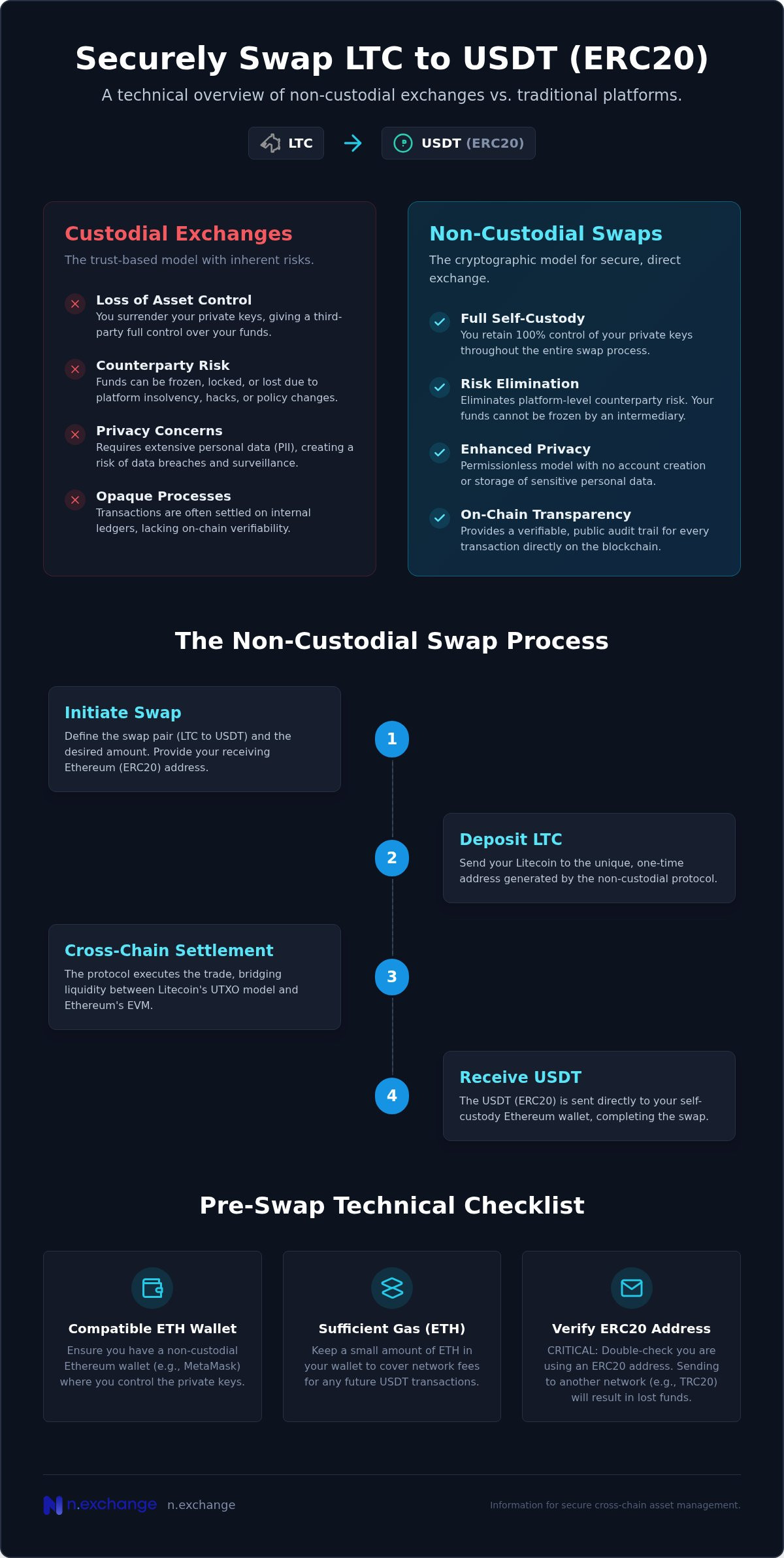
Selecting a non-custodial architecture for an LTC to USDT (ERC20) swap is a decision rooted in rigorous risk management. Centralized exchanges act as intermediaries, requiring users to relinquish control of their assets before a trade is finalized. This creates a single point of failure. Non-custodial swaps replace this trust-based model with a cryptographic one. Transactions occur directly between wallets, ensuring that assets are never subject to the internal policies or solvency risks of a third-party platform.
Mitigating Counterparty Risk
The primary threat in custodial environments is the “frozen fund” scenario. Centralized entities can halt withdrawals or lock accounts without notice, often citing opaque compliance triggers. Non-custodial security is the removal of third-party control over private keys. By maintaining key ownership, you ensure that your liquidity remains accessible regardless of platform status. This structural autonomy is essential for institutional players who cannot afford operational downtime. For a deeper analysis of these protections, consult our guide on Reducing Counterparty Risk in Crypto.
Privacy and Operational Efficiency
Operational overhead is a significant hurdle for fintech developers and high-volume traders. Traditional exchanges demand extensive account creation processes and sensitive personal data storage. Non-custodial systems offer a permissionless alternative. By removing the need for account management, these platforms eliminate the risk of data breaches involving user PII. This approach also reduces the compliance burden for businesses integrating swap functionality. They avoid the complexities of asset custody entirely.
Speed and transparency are inherent to this model. On-chain settlement provides a verifiable audit trail for every LTC to USDT (ERC20) transaction. There is no internal ledger to obscure the flow of funds. Settlement happens at the speed of the underlying blockchains. This directness allows for more predictable treasury management. Developers looking to implement these benefits can utilize a non-custodial crypto exchange API to streamline their cross-chain operations. This ensures a frictionless experience while upholding the highest security standards.
Technical Requirements for ERC20 Asset Reception
Successful execution of an LTC to USDT (ERC20) swap requires a high level of technical readiness on the receiving network. While the Litecoin side of the transaction is relatively straightforward, the Ethereum ecosystem operates on an account-based model that introduces specific requirements for asset liquidity and management. You must ensure your destination environment is fully prepared before initiating the swap to avoid operational delays or temporary loss of access to funds.
A common oversight is the lack of native ETH in the receiving wallet. USDT is an ERC20 token; it doesn’t power its own transactions on the Ethereum blockchain. Any subsequent movement of these funds requires ETH to pay for network gas. Without this reserve, your USDT becomes effectively stationary. We recommend maintaining a small ETH balance to ensure immediate liquidity upon the completion of your LTC to USDT (ERC20) transaction. This allows for rapid reallocation of assets if market conditions shift.
Managing Ethereum Gas Fees in 2026
By 2026, the Ethereum ecosystem has matured significantly, with Layer 2 solutions absorbing a large percentage of retail traffic. However, institutional USDT transfers often remain on Layer 1 for maximum security and direct liquidity access. Current network fee structures require users to monitor average gas limits, which can fluctuate based on smart contract complexity. Calculating an ETH buffer is essential; generally, keeping a small margin of ETH provides a sufficient buffer for multiple high-priority ERC20 transfers without needing to refuel the wallet.
Security Best Practices for Receiving Wallets
Non-custodial asset management relies entirely on the integrity of your private key storage. Hardware wallets provide the highest level of protection for ERC20 assets by keeping keys offline and away from potential network vulnerabilities. When providing a destination address, always use checksum-enabled interfaces to prevent character transposition errors. For developers building these capabilities into their own platforms, our Guide to Non-Custodial Crypto APIs for Fintechs offers deeper insights into secure implementation. Verifying the USDT contract interaction on a block explorer post-swap confirms that the assets are authentic and correctly allocated to your controlled address.
Executing the LTC to USDT (ERC20) Swap: A Practical Tutorial
Transitioning from technical theory to operational execution requires a methodical approach. The process begins with the selection of the LTC to USDT (ERC20) pair on your chosen non-custodial interface. This selection is a critical configuration step that directs the exchange logic to the correct liquidity pools. Precision at this stage prevents the accidental selection of incompatible USDT variants, which would result in a permanent loss of funds during the cross-chain transition.
After selecting the pair, you must provide a valid Ethereum destination address. This address must be under your direct control to maintain the security benefits of the non-custodial model. Once the destination is confirmed, the system generates a unique Litecoin deposit address. Sending the precise LTC amount to this address initiates the settlement process. Monitoring the transaction status on both the Litecoin and Ethereum block explorers provides the necessary transparency to verify that each stage of the swap is progressing as expected.
Step 1: Configuration and Quote
Infrastructure providers typically offer two pricing models: fixed and floating exchange rates. A fixed rate locks the execution price at the moment of initiation, providing protection against market volatility during the Litecoin network’s confirmation period. A floating rate adjusts based on market value at the moment the deposit is confirmed on-chain. Given that Litecoin blocks average 2.5 minutes, network confirmation times are relatively short, but institutional traders often prefer fixed rates for treasury predictability.
To verify a Litecoin transaction on-chain, enter your transaction ID into a public block explorer to monitor its status and confirmation count. Most non-custodial services require a specific number of confirmations before triggering the Ethereum-side settlement. This wait period ensures the finality of the LTC transfer before the USDT is released.
Step 2: Settlement and Verification
Once the LTC deposit reaches the required confirmation threshold, the system automatically executes the outbound USDT (ERC20) transfer. You can track this progress by monitoring the Ethereum transaction hash provided by the interface. This hash serves as a cryptographic receipt, proving that the smart contract has successfully released the funds to your destination address. Reading this hash on an Ethereum explorer allows you to confirm the contract interaction and the successful receipt of the assets.
In 2026, network delays are generally infrequent but can occur during extreme spikes in Ethereum Layer 1 activity. If the USDT does not appear within the expected timeframe, check the gas price associated with the outbound transaction hash. Low-priority gas settings during peak congestion can lead to processing queues. For professionals requiring institutional-grade execution and reliable settlement, you can execute an LTC to USDT (ERC20) swap using our high-liquidity infrastructure to ensure a frictionless experience.
Leveraging n.exchange Infrastructure for High-Liquidity Swaps
Established in 2016, n.exchange serves as a sophisticated liquidity provider for businesses requiring secure digital asset infrastructure. Our non-custodial model allows partners to offer high-performance swap services without the risks associated with holding user funds. By prioritizing institutional-grade quality, we provide a stable foundation for executing high-volume LTC to USDT (ERC20) transactions across various platforms. This infrastructure is engineered for 24/7 operational reliability, ensuring that liquidity is available regardless of market volatility or network congestion.
For fintech developers, the embeddable exchange widget offers a streamlined path to integration. This modular tool allows for the rapid deployment of cross-chain swap capabilities with minimal development resources. Businesses can maintain their own brand identity while leveraging our underlying liquidity and settlement logic. This modular approach reduces time-to-market for new financial products, allowing companies to focus on user acquisition rather than complex backend engineering. It ensures that the technical burden of bridging Litecoin and Ethereum remains invisible to the end-user.
The API-First Advantage for Developers
Our Exchange API provides a unified endpoint for standardizing complex cross-chain operations. Developers can programmatically execute an LTC to USDT (ERC20) swap by interacting with a well-documented, RESTful architecture. This eliminates the need to manage individual blockchain nodes or maintain separate integrations for different asset standards. For detailed implementation strategies, refer to The Developer Handbook for Crypto API Integration. This documentation outlines best practices for maintaining security and performance during high-frequency API calls, ensuring structural integrity across all custom fintech applications.
White-Label Solutions for Rapid Deployment
Financial institutions seeking to launch their own branded exchange services can utilize our turnkey white-label exchange solution. This product includes full support for the Litecoin to Ethereum bridge, managed by our high-liquidity infrastructure. By outsourcing the technical complexity of exchange logic and liquidity management, partners can scale their core business operations efficiently. Our framework for Evaluating White Label Exchange Providers helps decision-makers identify the structural requirements for long-term success. This strategic alignment ensures that your platform remains secure, compliant, and performant in the competitive 2026 digital asset landscape.
Optimizing Cross-Chain Liquidity Workflows
Mastering the transition between Litecoin’s UTXO model and the Ethereum ecosystem requires more than just a simple swap tool. It demands a structural commitment to non-custodial security. By prioritizing private key ownership, you eliminate the systemic risks of centralized intermediaries while maintaining operational agility. Successful execution of an LTC to USDT (ERC20) swap depends on technical precision, specifically regarding Ethereum gas management and the verification of smart contract interactions on-chain. This methodical approach ensures that your assets remain under your control throughout the entire settlement lifecycle.
As digital asset markets continue to mature in 2026, the need for reliable, API-first liquidity solutions has become a standard for fintech professionals. Our infrastructure provides the stability and performance required for high-volume transactions without the friction or risk of custodial services. You can execute your LTC to USDT (ERC20) swap securely on n.exchange, leveraging a non-custodial architecture that has supported the industry since 2016. Secure your liquidity with institutional-grade tools designed for long-term structural integrity and seamless cross-chain integration.
Frequently Asked Questions
Is LTC to USDT (ERC20) a cross-chain swap?
Yes, this transaction is a cross-chain swap. It requires a technical bridge to move value from the Litecoin blockchain, which uses a UTXO model, to the Ethereum network, where USDT exists as a smart-contract-based asset. These two ecosystems aren’t natively compatible; therefore, a liquidity provider must facilitate the atomic exchange of value across these distinct architectural layers while ensuring the transaction remains verifiable on both ledgers.
How long does a Litecoin to Ethereum-based USDT swap take?
The duration of the swap depends primarily on the confirmation times of the underlying blockchains. Litecoin blocks are generated approximately every 2.5 minutes, and most providers require multiple confirmations to ensure finality. Once the LTC deposit is confirmed, the Ethereum-side settlement is initiated. In 2026, network congestion on Ethereum Layer 1 can occasionally extend the total processing time, though the process typically concludes within 15 to 30 minutes.
Do I need ETH in my wallet to receive USDT (ERC20)?
You don’t need ETH in your wallet to receive the tokens, but you’ll need it for any subsequent transactions. Ethereum network protocols require ETH to pay for the gas fees associated with moving ERC20 assets. If your destination wallet is empty, your USDT will remain stationary until you deposit enough ETH to cover the network’s computational costs. Maintaining a small ETH buffer is a standard operational requirement for managing any Ethereum-based liquidity.
What is the difference between USDT (ERC20) and USDT (TRC20)?
The primary difference lies in the host network and the associated operational costs. USDT (ERC20) operates on the Ethereum blockchain, offering deep integration with the DeFi ecosystem and institutional-grade security. USDT (TRC20) resides on the Tron network and generally features lower transaction fees. While both represent the same stablecoin value, they aren’t cross-compatible. You must ensure your receiving wallet matches the specific network standard selected during the swap process.
Can I swap LTC for USDT without a centralized exchange account?
Yes, you can execute an LTC to USDT (ERC20) swap without creating a centralized exchange account. Non-custodial platforms facilitate direct wallet-to-wallet transactions, removing the need for sensitive personal data storage or account management. This permissionless architecture allows for greater privacy and significantly reduces the compliance burden for fintech developers. Users maintain control of their private keys throughout the entire process, which eliminates the risk of funds being frozen by a centralized intermediary.
What are the fees associated with swapping LTC to USDT (ERC20) in 2026?
Fees for an LTC to USDT (ERC20) swap consist of the blockchain network fees and the service provider’s liquidity fee. The Litecoin network fee covers the cost of sending your initial deposit, while the Ethereum gas fee covers the outbound USDT transfer. In 2026, Ethereum fees vary based on Layer 1 congestion and smart contract complexity. Service fees are typically built into the exchange rate quote to ensure transparency and predictable settlement for high-volume traders.
How do I verify that my LTC to USDT swap was successful on-chain?
Verification is achieved by analyzing the transaction hashes on the respective block explorers. You should first confirm the LTC deposit status on a Litecoin explorer to ensure it has reached the required confirmation threshold. Subsequently, use the provided Ethereum transaction hash to verify the contract interaction on an explorer like Etherscan. A successful status on the Ethereum ledger confirms that the USDT (ERC20) has been correctly allocated to your destination address and is ready for use.
Is n.exchange a non-custodial platform?
n.exchange is a non-custodial liquidity provider that has been operating since 2016. The platform’s architecture is designed to facilitate digital asset swaps without ever taking possession of user funds. By utilizing an API-first approach, it provides institutional-grade infrastructure for businesses and individual users who prioritize security and asset control. This model ensures that you retain full ownership of your private keys, providing a reliable alternative to the counterparty risks associated with custodial platforms.