
With over 51% of the world’s circulating Tether now hosted on the TRON network, the demand for efficient liquidity bridges to the XRP Ledger has reached a critical threshold. Most sophisticated traders recognize that while TRON provides significant velocity for stablecoins, moving assets into the XRP ecosystem often introduces counterparty risk through centralized intermediaries. You shouldn’t have to relinquish control of your private keys to access cross-chain liquidity. Managing a USDT (TRC20) to XRP swap requires a protocol that balances high-performance routing with strict operational security.
This guide provides a technical framework for executing secure, high-liquidity swaps without the vulnerabilities associated with custodial platforms. You will learn how to navigate specific network requirements, from managing TRON energy costs to correctly implementing XRPL destination tags for institutional or private wallets. We focus on a streamlined path that minimizes transaction costs while ensuring the successful delivery of native XRP to your destination address. By the end of this article, you will understand how to utilize non-custodial architecture to maintain structural integrity throughout the entire exchange process.
Key Takeaways
- Identify the technical distinctions between TRON’s high-speed stablecoin execution and the XRP Ledger’s consensus model for rapid settlement.
- Eliminate counterparty risk by utilizing a non-custodial architecture that ensures you never relinquish control of your private keys.
- Master the 5-step protocol for a USDT (TRC20) to XRP swap, including the critical implementation of destination tags for secure delivery.
- Optimize transaction efficiency by understanding how institutional-grade liquidity sourcing minimizes slippage on cross-chain pairs.
- Discover how to scale these swap capabilities within your own infrastructure using a robust Exchange API or an embeddable widget.
TRC20 vs. Ripple Network: Understanding the Bridge
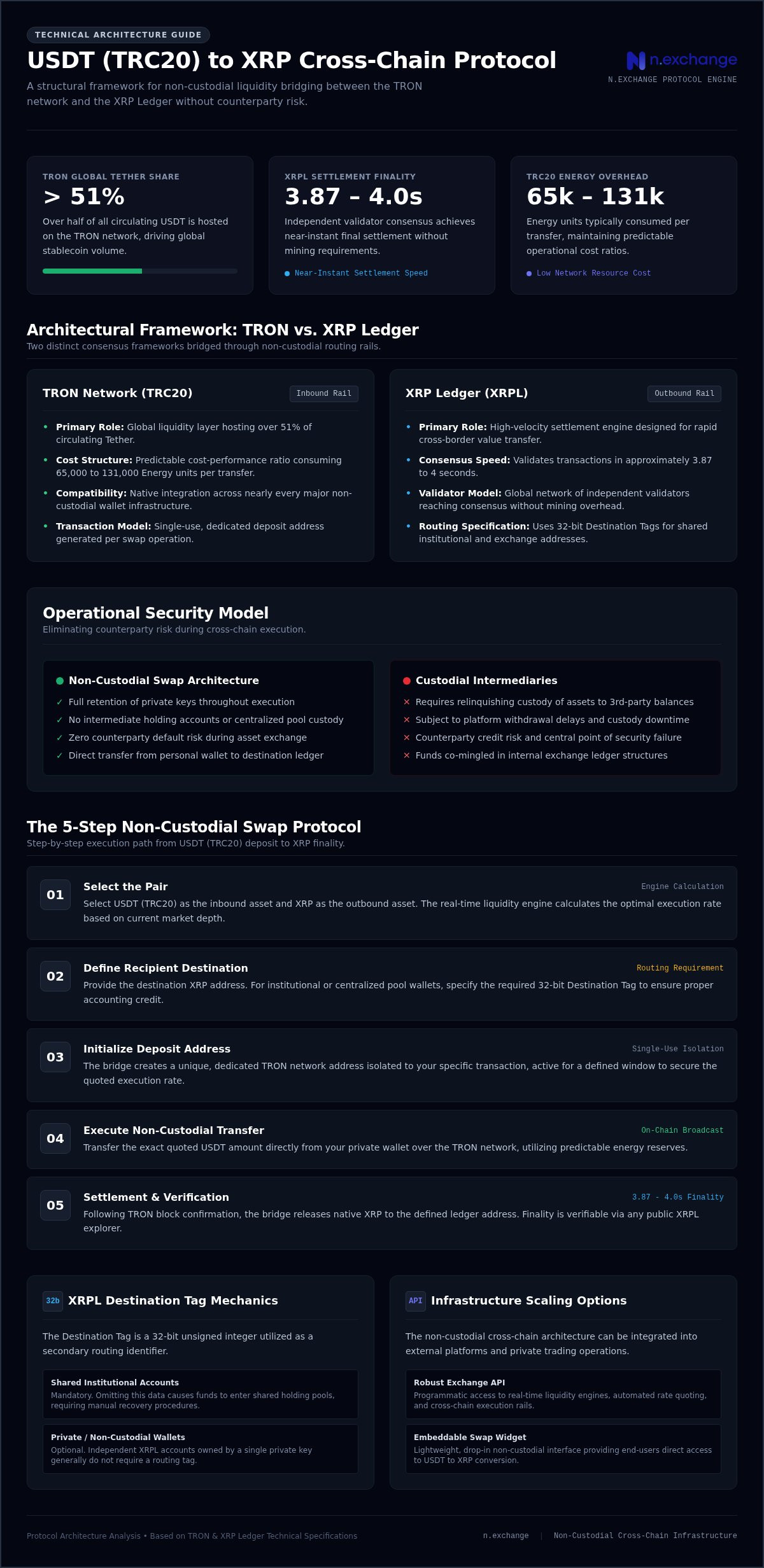
Executing a USDT (TRC20) to XRP swap requires bridging two distinct architectural frameworks. The TRON network serves as the primary host for global stablecoin liquidity, currently supporting over 51% of all circulating Tether. In contrast, the XRP Ledger functions as a high-velocity settlement engine designed for near-instant cross-border value transfer. Because these networks utilize incompatible consensus mechanisms, a specialized non-custodial bridge is required to facilitate the exchange without requiring users to deposit funds into a centralized holding account.
Why USDT (TRC20) is the Preferred On-Ramp
By 2026, the TRON network has solidified its position as the most efficient layer for stablecoin operations. While Ethereum-based ERC20 transfers often face fluctuating gas costs, TRON maintains a predictable cost-performance ratio that is ideal for mid-to-high volume swaps. Standard USDT transfers on TRON typically consume between 65,000 and 131,000 Energy units, resulting in significantly lower overhead than legacy smart contract platforms. This technical efficiency is supported by nearly every major non-custodial wallet, making TRC20 the most accessible entry point for traders seeking to move into XRP.
XRP Ledger (XRPL) Performance Metrics
The XRP Ledger provides the structural finality required for institutional-grade asset movement. Unlike Proof of Work systems that require multiple block confirmations, the XRP Ledger consensus protocol validates transactions in approximately 3.87 to 4 seconds. This speed ensures that the outbound leg of a swap is settled almost immediately after the TRON deposit is confirmed. Operational reliability is maintained by a global network of independent validators that reach consensus without the energy-intensive requirements of mining. For 2026, XRPL transaction finality remains the industry benchmark for speed and technical resilience.
The Destination Tag Requirement
Successful delivery of XRP depends on the precise use of the Destination Tag. While personal non-custodial wallets don’t always require this 32-bit identifier, it is mandatory when sending funds to shared institutional accounts or centralized exchange wallets. This tag acts as a unique routing instruction within a larger pool wallet. Omitting this data point when it’s required often leads to manual recovery processes that disrupt the efficiency of the USDT (TRC20) to XRP exchange. A non-custodial bridge ensures this data is processed correctly, maintaining a direct line between your TRON-based assets and your XRP destination.
How to Swap USDT (TRC20) to XRP in 5 Steps
Transitioning from the theoretical framework to operational execution requires a structured approach. The following protocol ensures that your USDT (TRC20) to XRP exchange is completed with technical precision and minimal exposure to risk. By following these steps, you maintain full control over your assets while utilizing institutional-grade liquidity rails.
- Step 1: Select the Pair. Access the interface and choose USDT (TRC20) as the input asset and XRP as the output. This action triggers the real-time liquidity engine to calculate the most efficient execution rate based on current market depth.
- Step 2: Define Destination. Enter your recipient XRP address. If you’re routing funds to a shared institutional wallet or a centralized platform, you must include the 32-bit Destination Tag to ensure the funds are credited to your specific account.
- Step 3: Initialize the Deposit. The system will generate a unique, single-use TRON network address. This address is dedicated solely to your specific transaction and remains active for a limited window to secure the quoted rate.
- Step 4: Execute the Transfer. Send the exact amount of USDT from your non-custodial wallet. As highlighted in Federal Reserve research on stablecoins, the high liquidity and operational structure of these assets facilitate rapid settlement across disparate blockchain environments.
- Step 5: Confirm Settlement. Once the TRON transaction is validated, the engine releases native XRP. You can verify the finality of the payout by checking the transaction hash on a public XRPL explorer.
Technical Requirements for the Swap
Operational success depends on meeting specific network criteria before initiating the transfer. Your TRON wallet must contain sufficient TRX to cover energy and bandwidth costs, typically requiring 6.5 to 13.45 TRX depending on whether the recipient address already holds USDT. Additionally, new XRP accounts must satisfy the base reserve requirement of 1 XRP to remain active on the mainnet. Double-verifying the Destination Tag remains the most critical step for users sending to custodial platforms, as errors here can lead to lengthy recovery procedures. For a secure and direct experience, you can initiate a crypto swap through our non-custodial interface.
Monitoring Transaction Status
Real-time transparency is a core feature of non-custodial architecture. You can monitor the progress of your USDT (TRC20) to XRP exchange by utilizing blockchain explorers like TronScan for the deposit phase and XRPScan for the settlement phase. A “Pending” status indicates the network is reaching consensus, while “Completed” signifies that the assets have been successfully delivered to your private wallet. Every transaction is assigned a unique tracking ID, allowing for granular oversight of the liquidity matching and settlement process without the need for an account.
Eliminating Counterparty Risk with Non-Custodial Architecture
In 2026, the principle of “Not your keys, not your coins” has transitioned from a community slogan to a mandatory operational standard for institutional participants. Centralized exchanges often function as a single point of failure (SPOF), where a single technical breach or insolvency event can compromise billions in user assets. By contrast, a non-custodial USDT (TRC20) to XRP swap ensures that you retain exclusive control over your private keys throughout the entire transaction lifecycle. Assets move directly from the TRON network to the XRP Ledger without ever residing in a platform-managed wallet. This structural integrity is essential for users who prioritize operational security over the convenience of a centralized dashboard.
Strategic Benefits of Non-Custodial Systems
Adopting decentralized infrastructure provides significant benefits of non-custodial architecture for professional traders and fintech developers. This model fundamentally eliminates the risk of catastrophic exchange hacks because there’s no central honeypot of funds for malicious actors to target. For US-based fintech developers, this approach offers clear compliance advantages by removing the legal complexities of asset custody. By utilizing n.exchange’s non-custodial rails, you mitigate the systemic risks of platform insolvency while maintaining the high-speed execution required for modern digital asset markets. This architecture allows for a more resilient financial stack that isn’t dependent on the health of a single corporate entity.
Reducing Counterparty Risk
The core of a secure swap is the total elimination of the middleman. Research by the Federal Reserve Bank of New York highlights the severe counterparty risks associated with centralized crypto intermediaries, noting that custodial structures often lack the transparency found in on-chain alternatives. Implementing a strategic reducing counterparty risk in crypto framework involves using atomic-like swap logic, where the final settlement of XRP is programmatically triggered by the confirmation of the USDT deposit on the TRON blockchain. This mechanism allows a USDT (TRC20) to XRP exchange to function with full transparency and without a central clearinghouse. Non-custodial swaps effectively prevent the risk of sudden asset freezes or administrative holds on your capital during periods of market volatility.
Optimizing Efficiency: Liquidity and Slippage
Efficiency in a USDT (TRC20) to XRP exchange is defined by the delta between the quoted price and the final settlement value. This delta, known as slippage, often fluctuates based on real-time market depth and the speed of network confirmations. Unlike legacy aggregators that display nominal rates without accounting for execution depth, a professional infrastructure partner prioritizes high-liquidity routing. This ensures that even during periods of high volatility, the price impact remains within institutional tolerances. Successful execution depends on matching orders against deep liquidity pools that can absorb volume without significant price shifts.
Network performance directly influences execution quality. The TRON network’s massive USDT throughput ensures that liquidity is almost always available for the entry leg of the swap. However, the four-second finality of the XRP Ledger is the critical component for completing the USDT (TRC20) to XRP transition. If the deposit leg on TRON is delayed due to network resource spikes, the price of XRP may shift before the outbound leg is triggered. Professional traders often monitor network resource costs to ensure their swaps are processed during windows of optimal market depth.
Evaluating Exchange Rates
Choosing between fixed and floating rates is a strategic decision based on your risk appetite and the current market environment. Fixed rates provide a guaranteed execution price, where the platform absorbs the micro-volatility risks during the settlement window. Floating rates may offer better value when market conditions are stable or improving. For a technical comparison of network overhead, our guide on LTC to USDT (ERC20) illustrates how the TRC20 and XRPL networks offer superior cost-performance ratios compared to Ethereum-based assets. Transparency in these fee structures is vital for professional traders who need to maintain predictable margins.
High-Volume Swap Considerations
Managing large-scale orders requires access to aggregated liquidity pools rather than relying on individual retail order books. Standard XRPL order books have technical limits regarding depth at specific price points, which can lead to significant price impact for six-figure transfers. n.exchange addresses this by utilizing sophisticated routing algorithms that distribute orders across multiple liquidity providers simultaneously. This structural approach allows for the execution of institutional-sized swaps without destabilizing the pair’s market price. To experience optimized execution for your next transaction, you can initiate a non-custodial USDT to XRP swap today.
Scaling with n.exchange Infrastructure
For organizations looking to move beyond manual swaps, establishing a programmatic connection to cross-chain liquidity is the next logical step. The ability to execute a USDT (TRC20) to XRP exchange at scale requires a robust infrastructure that can handle high-frequency requests without compromising security. n.exchange provides a suite of modular tools designed for seamless integration into existing financial stacks, allowing businesses to leverage non-custodial architecture as a core service component. This approach ensures that institutional-grade reliability is accessible to fintech developers and enterprise partners alike.
API Integration for Developers
The n.exchange API serves as the backbone for institutional-grade asset movement. Developers can access standardized RESTful endpoints to fetch real-time quotes, initialize transactions, and monitor settlement status across the TRON and XRP networks. Consulting the developer documentation for a crypto API provides a technical roadmap for implementing these features with maximum efficiency. By automating the USDT (TRC20) to XRP workflow, fintech applications can provide their users with instant liquidity while maintaining a strictly non-custodial posture. This programmatic approach eliminates the operational bottlenecks of manual trade execution and allows for rapid scaling of transaction volumes.
White Label and Widget Solutions
For businesses that require a turnkey frontend experience, the embeddable exchange widget offers a low-code solution for deploying swap functionality. This tool allows partners to integrate the USDT to XRP pair directly into their own websites or mobile applications with minimal development overhead. When evaluating white label exchange providers, it’s essential to prioritize platforms that offer deep customization and transparent revenue sharing. A white label exchange solution allows you to monetize transaction flow while providing a branded, high-performance interface for your users. These modular components ensure that your infrastructure can grow in tandem with your user base without the need for extensive in-house development.
Comprehensive developer support and well-documented technical specifications ensure that the integration process is frictionless. Every component of the n.exchange ecosystem is built on the same non-custodial foundation established in 2016, providing the stability required for long-term operational success. Whether you are deploying a single widget or a complex API-driven ecosystem, the focus remains on delivering secure, high-liquidity swaps that empower your business to navigate the cross-chain landscape with confidence. This structural excellence positions you as a reliable infrastructure partner for your own end-users.
Secure Your Cross-Chain Liquidity
Successfully managing a USDT (TRC20) to XRP exchange requires a protocol built on technical precision and non-custodial security. By prioritizing an architecture that eliminates counterparty risk, you maintain absolute control over your private keys while benefiting from the near-instant finality of the XRP Ledger. The synergy between TRON’s massive stablecoin liquidity and the XRPL’s institutional-grade settlement engine provides a robust framework for professional traders. High-performance execution and transparent pricing ensure your capital moves with maximum efficiency across these distinct networks.
Whether you’re executing a single trade or scaling operations through an API-first infrastructure, the focus remains on operational excellence and structural integrity. You can launch your USDT (TRC20) to XRP swap now on n.exchange to experience a streamlined, professional exchange process. Technical discipline is the most reliable way to navigate the complexities of cross-chain asset movement. Start your transaction today with the quiet assurance that your infrastructure partner is built for performance and security.
Frequently Asked Questions
Do I need to undergo KYC for a USDT (TRC20) to XRP swap?
n.exchange prioritizes a streamlined user experience by utilizing a non-custodial architecture. While many traditional platforms require extensive documentation for every transaction, our infrastructure focuses on direct asset movement. Compliance requirements are determined by automated risk-scoring systems and transaction volume. This approach allows professional users to maintain operational velocity while ensuring that the platform remains aligned with international regulatory standards for digital asset service providers.
What is the minimum amount for swapping USDT to XRP on n.exchange?
The minimum threshold for a USDT (TRC20) to XRP swap is determined dynamically by the underlying network requirements. This calculation accounts for TRON network resource costs, such as energy and bandwidth, and the XRP Ledger’s base reserve requirement. Because these costs fluctuate based on network congestion, the interface provides a real-time minimum quote. This ensures that every transaction has sufficient value to cover on-chain fees while maintaining high-liquidity execution.
How long does a TRC20 to XRP transaction typically take in 2026?
In 2026, the total duration for a swap is typically measured in minutes. TRON network confirmations for the USDT deposit leg usually occur within three seconds. Once the deposit is validated, the XRP Ledger consensus protocol ensures transaction finality in approximately 3.87 to 4 seconds. The cumulative time includes these network intervals plus the internal processing speed of the liquidity matching engine, resulting in a fast and efficient settlement process.
What happens if I forget to include the XRP Destination Tag?
Forgetting the Destination Tag depends on the nature of the recipient wallet. If you’re sending XRP to a private, non-custodial wallet, the funds will arrive safely as you control the entire address. However, if the destination is a centralized exchange or a shared institutional wallet, the funds will be lost in a general pool. This requires a manual, time-intensive recovery process through the recipient’s support team to identify your specific transaction.
Are there any hidden fees in the USDT to XRP exchange rate?
Transparency is a fundamental pillar of our institutional-grade service. All costs associated with the swap are integrated into the final quoted exchange rate you see before confirming the transaction. This includes liquidity provider spreads and network delivery fees. We avoid the hidden charges often found in legacy brokerage models, ensuring that professional traders can accurately calculate their margins and maintain predictable operational costs across all cross-chain pairs.
Can I swap USDT (TRC20) to XRP directly from my hardware wallet?
You can execute a swap directly from any hardware wallet that supports the TRON and XRP networks. Because n.exchange is a non-custodial infrastructure provider, you simply send the USDT from your device to the unique deposit address provided. The resulting XRP is then delivered directly to the address associated with your hardware wallet. This process ensures you never relinquish control of your private keys to a third-party intermediary.
Is n.exchange available for US-based fintech integration?
Our infrastructure is fully available for US-based fintech integration and professional use. We provide a robust Exchange API and an embeddable widget specifically designed for developers and businesses operating within the United States. This national coverage allows domestic platforms to offer secure USDT (TRC20) to XRP swaps to their own users. Our white-label solutions are engineered to meet the technical and stability requirements of the modern US financial landscape.
What is the difference between USDT (TRC20) and USDT (ERC20) for this swap?
The primary difference lies in the underlying blockchain architecture and operational costs. USDT (TRC20) operates on the TRON network, which offers significantly lower transaction fees and higher throughput compared to the Ethereum-based ERC20 version. For a USDT (TRC20) to XRP swap, using the TRON-based asset is generally more efficient for high-volume traders. Choosing the correct network is critical, as sending assets to an incompatible address will result in a permanent loss of funds.