Relying on centralized intermediaries for cross-chain liquidity is an outdated architecture that introduces unnecessary counterparty risk and operational latency. For high-frequency traders and fintech integrators, the traditional friction of mandatory registration and custodial holding periods creates a significant barrier to capital efficiency. Executing a USDC to SOL swap requires a more sophisticated approach, one that prioritizes direct wallet delivery and institutional-grade security protocols without sacrificing speed.
You’re likely aware that legacy bridges often suffer from high slippage and complex execution paths that compromise the integrity of your transaction. This technical guide demonstrates how to master the USDC to SOL swap process through a non-custodial framework that leverages 0-TVL intent architectures and native settlement. By shifting away from lock-and-mint models, you maintain total control over your assets while benefiting from the 400ms slot times of the Solana network.
We’ll explore the critical role of Circle CCTP V2 in achieving fast finality and the specific mint addresses required for native SPL USDC. This analysis also covers how to integrate embeddable exchange widgets and APIs to streamline cross-chain workflows. By the end of this article, you’ll have the technical foundation to execute swaps with minimal friction and maximum liquidity depth.
Key Takeaways
- Understand why non-custodial architecture is the industry standard for eliminating counterparty risk and maintaining total asset control.
- Learn the precise technical steps required to execute a USDC to SOL swap with direct delivery to a Solana wallet.
- Discover how to evaluate liquidity depth and network congestion to ensure institutional-grade execution and minimal slippage.
- Explore professional integration methods for embedding cross-chain swap functionality into third-party platforms via API and widgets.
- Identify the core differences between native SPL USDC settlement and legacy wrapped-token bridges to optimize transaction security.
Understanding USDC to SOL Cross-Chain Dynamics
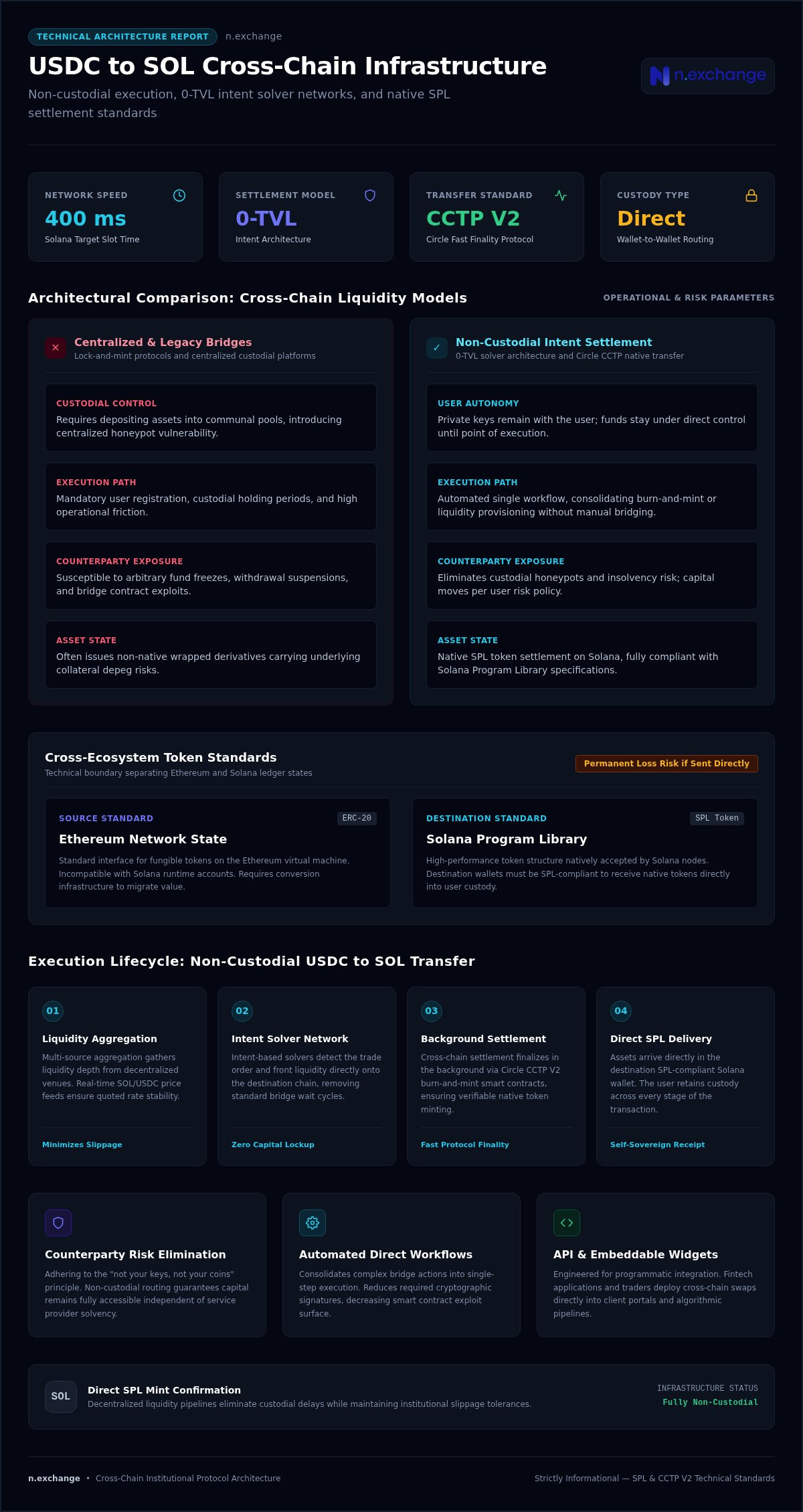
Executing a USDC to SOL swap represents more than a simple currency exchange; it’s a strategic cross-ecosystem value transfer between distinct architectural environments. USDC functions as a multi-chain stablecoin, existing natively on various protocols such as Ethereum (ERC20) and Solana (SPL). Because these blockchains don’t communicate directly, a technical infrastructure is required to facilitate the movement of value across these disparate layers. A professional-grade swap ensures that liquidity is sourced effectively to deliver assets without the delays or counterparty risks associated with centralized ledger updates.
The Role of Liquidity in Cross-Chain Swaps
Liquidity is the fundamental driver of execution quality. Non-custodial platforms aggregate depth from multiple decentralized sources to minimize slippage, which is critical when managing institutional-grade volume. Real-time price feeds for the SOL/USDC pair allow for precise execution, ensuring that the rate quoted at the start of the transaction remains stable throughout the confirmation process. Operational excellence in this context means managing network latency with precision. By utilizing intent-based solver networks, the infrastructure can front liquidity on the destination chain, resulting in near-instant delivery to the user’s wallet while the cross-chain settlement finalizes in the background.
Network Standards: ERC20 vs. SPL
The primary technical hurdle in a USDC to SOL transition lies in the incompatibility of network standards. While most legacy stablecoin holdings reside as ERC20 tokens on Ethereum, the Solana blockchain platform requires tokens to follow the SPL (Solana Program Library) standard. Sending ERC20 tokens directly to a Solana address is technically impossible and would result in a permanent loss of funds.
Professional swap services resolve this by performing a direct conversion that bypasses the friction and security risks of manual bridging. This process requires a destination wallet that is fully SPL-compliant to receive the native assets. Direct swaps are inherently more efficient than manual bridges because they consolidate the burn-and-mint or liquidity-provisioning steps into a single, automated workflow. This optimization reduces the number of required signatures and minimizes exposure to bridge-related smart contract vulnerabilities, providing a streamlined path for capital migration.
The Security Advantages of Non-Custodial Swapping
Non-custodial architecture represents the gold standard for institutional digital asset management. Unlike centralized exchanges, which require users to deposit funds into a communal pool, non-custodial systems ensure that assets remain under the user’s direct control until the moment of execution. This shift eliminates the most critical vulnerability in the trade lifecycle: the centralized honeypot. By utilizing a non-custodial infrastructure for a USDC to SOL swap, you significantly reduce the risk of platform-wide breaches that target custodial wallets. The reduced attack surface is a primary reason why sophisticated participants favor direct, wallet-to-wallet protocols.
Reducing Counterparty Risk
The philosophy of “not your keys, not your coins” is a fundamental security requirement for professional stablecoin exits. Non-custodial frameworks prevent the risk of arbitrary fund freezes or withdrawal suspensions that often plague centralized platforms during market stress. This level of autonomy is detailed in our guide on Reducing Counterparty Risk in Crypto: A Strategic Framework for 2026. Because the exchange does not hold your private keys, your capital remains accessible even if the service provider faces operational challenges. You retain the ability to move assets according to your own internal risk management policies rather than the platform’s solvency.
Operational Stability and Uptime
Decentralized liquidity infrastructure provides a more resilient foundation compared to the rigid silos of centralized ledgers. API-driven execution allows for automated, programmatic swaps that bypass the manual friction of traditional interfaces. These flows are secured by audited smart contracts that facilitate the burn-and-mint process. For a deeper technical understanding of these permissionless transfers, consult the Circle Cross-Chain Transfer Protocol documentation. This protocol allows for native settlement without relying on risky wrapped-token bridges. The result is a stable environment where uptime is maintained through distributed network consensus rather than a single point of failure.
Privacy is a core component of structural integrity. Professional non-custodial services allow for a USDC to SOL exchange without mandatory account creation or invasive registration barriers. This approach minimizes the amount of sensitive corporate data stored on third-party servers, further reducing the risk of identity theft or data leaks. Every transaction is verifiable on public block explorers, providing a transparent audit trail that satisfies both internal compliance and external regulatory scrutiny. If you require a secure, direct path for asset migration, you can initiate a non-custodial swap to experience institutional-grade execution firsthand.
Step-by-Step: How to Swap USDC to SOL
Executing a USDC to SOL swap through a non-custodial interface ensures that you maintain control of your private keys while accessing institutional-grade liquidity. The process is designed for technical efficiency, removing the need for account creation or custodial deposits. To begin, select USDC as your source currency and SOL as the destination asset. This selection establishes the specific cross-chain route the infrastructure will follow to fulfill your request.
Next, input the precise amount you intend to swap. The system will prompt you for a valid Solana destination address. It’s vital to verify this address multiple times; once assets are dispatched on-chain, the transaction is immutable. Before committing funds, analyze the provided exchange rate and associated network fees. This level of transparency is a core feature of non-custodial architectures, which aim to mitigate the risks highlighted in academic research on cross-chain bridge security and attack surfaces.
After verification, the interface generates a unique, non-custodial deposit address. You must send your USDC to this specific address from your source wallet. Once the network confirms your deposit, the system automatically triggers the delivery of SOL to your specified Solana wallet. The USDC to SOL flow is completed once the blockchain confirms the final settlement on the destination chain.
Wallet Preparation for Solana
Before initiating the swap, you must ensure your destination wallet is fully initialized and SPL-compliant. Solana utilizes a unique addressing scheme that differs significantly from EVM-based chains like Ethereum. A Solana address format is an alphanumeric string of 32 to 44 characters. Double-checking this string is the most effective way to prevent the permanent loss of assets during the transfer process. It’s also recommended to have a small amount of SOL already present to cover any immediate on-chain interactions after the swap.
Monitoring the Transaction
Real-time transparency is a hallmark of professional blockchain operations. You can track the progress of your incoming SOL using block explorers such as Solscan. It’s helpful to understand that confirmation times vary significantly between networks. While Ethereum confirmation might take several minutes depending on gas prices, Solana transactions typically finalize in under a second. If a transaction requires technical review, you should utilize the unique transaction ID provided by the exchange interface. This ID serves as the definitive record of the swap and is essential for any support inquiries or internal audit requirements.
Optimizing Performance for Professional Swaps
High-performance trading requires a deep understanding of network variables. Congestion on the source blockchain can impact the speed of the initial USDC deposit, which in turn affects the timing of the final SOL delivery. Professional participants evaluate network status in real-time to ensure their capital moves during periods of optimal throughput. This proactive approach minimizes the risk of execution delays during high-volatility events.
Capture institutional-grade pricing by analyzing the total cost of the swap rather than the headline rate. This includes accounting for network fees, slippage, and the spread. For high-volume traders, an API-first approach is the most effective way to manage these variables. Automating the USDC to SOL process allows for precise execution at scale, removing the latency and potential for error inherent in manual interfaces.
Liquidity and Slippage Management
n.exchange maintains deep liquidity for the USDC/SOL pair by aggregating depth from multiple institutional sources. This strategy ensures that large orders are executed with minimal slippage, providing a significant advantage over traditional CEX spot markets where liquidity can be fragmented. Managing “dust” and minimum swap requirements is also critical for balance sheet efficiency. Clear parameters around minimum trade sizes ensure that capital isn’t trapped in sub-optimal denominations. If you require consistent execution for large-scale operations, you can access our deep liquidity pools through our non-custodial interface.
Technical Efficiency in Cross-Chain Execution
Direct conversion offers a distinct speed advantage over multi-step bridging protocols. By eliminating intermediate wrapped tokens, you reduce both gas costs and smart contract risk. This streamlined flow is a core component of professional asset management. For a comprehensive look at these frameworks, refer to The Institutional Guide to Non-Custodial Crypto Exchanges. This document provides the structural insights needed to manage USDC to SOL swaps at an institutional level. Choosing the right network for your source USDC is equally important; selecting a chain with lower egress fees can significantly improve the net result of your swap.
Integrating USDC to SOL Swaps via API and Widget
Programmatic access to liquidity is a critical requirement for platforms seeking to retain users within their native environments. By integrating a USDC to SOL swap directly into an interface, businesses eliminate the need for users to exit the ecosystem to find external liquidity providers. The n.exchange embeddable widget offers a low-code solution for this requirement; it allows third-party websites to host a professional exchange interface with minimal development overhead. For more complex requirements, the exchange API provides granular control over transaction parameters, including fee structures and pair availability. This flexibility allows for a seamless alignment with existing business logic.
This infrastructure is particularly valuable for digital wallet providers. Adding a native swap functionality improves the operational utility of the wallet, transforming it from a storage solution into a comprehensive financial tool. It allows users to rebalance their portfolios or exit stablecoin positions into native SOL without the friction of manual transfers between platforms. This integration creates a more cohesive user experience while generating a consistent revenue stream through volume-based fees. It is a strategic move that enhances both user retention and platform utility.
Developer-First Integration
Implementation of the iframe widget is designed for speed and technical simplicity. Developers can embed the exchange module into any web application by adding a few lines of code. This modular approach supports deep UI customization, allowing partners to align the widget’s aesthetic with their brand’s existing user flow. Technical documentation and execution patterns are detailed in The Developer’s Handbook for Crypto API Integration: Documentation & Best Practices. This resource ensures that your integration follows industry-standard security protocols while maximizing transaction success rates. It’s an essential guide for maintaining structural integrity during the deployment phase.
Scaling with White-Label Solutions
Fintech startups often require a faster time-to-market than custom development allows. A white-label exchange solution provides a turnkey infrastructure that includes liquidity management, compliance-ready reporting, and a polished user interface. This model allows businesses to offer a branded USDC to SOL service while maintaining the rigorous non-custodial security standards established by the underlying protocol. For organizations evaluating their options, Evaluating White Label Exchange Providers: A Strategic Comparison Framework for 2026 provides a methodology for selecting a partner based on structural integrity and performance metrics. By leveraging a proven infrastructure, partners can focus on user acquisition rather than the complexities of backend liquidity routing.
Advancing Cross-Chain Liquidity Standards
Transitioning from legacy custodial models to non-custodial frameworks is essential for maintaining asset control and operational security. By prioritizing direct settlement and eliminating registration barriers, you ensure that capital remains mobile. This guide has detailed the technical requirements for a successful USDC to SOL swap, emphasizing the importance of native SPL compliance and institutional-grade liquidity routing. Whether you’re executing a single trade or integrating these capabilities into a fintech stack, the focus must remain on structural integrity.
n.exchange has provided a reliable, non-custodial infrastructure since 2016. Our platform offers the stability needed for high-volume execution without the friction of mandatory accounts. You can start your secure USDC to SOL swap on n.exchange now to experience a professional exchange environment designed for performance. Establishing a robust cross-chain strategy today positions your operations for long-term success in a multi-chain ecosystem. It’s time to leverage the speed and security of modern liquidity architectures.
Frequently Asked Questions
Is a registration or KYC process required to swap USDC to SOL?
No registration or KYC process is required for a standard USDC to SOL swap on n.exchange. The platform operates on a non-custodial model that prioritizes privacy and operational speed for all participants. By eliminating the need for account creation, you can initiate transactions instantly without sharing sensitive personal data. This approach reduces the risk of data breaches and ensures that your financial activity remains confidential while providing a streamlined path for asset migration.
How long does a typical USDC to SOL swap take to complete?
A typical swap usually completes within a few minutes, though the exact duration depends on the source network’s confirmation speed. While the Solana network finalizes transactions in under a second, the initial USDC deposit must be confirmed on its native blockchain, such as Ethereum or Polygon. Once n.exchange detects the incoming deposit, the SOL is dispatched to your destination wallet immediately. This automated process ensures that your capital is moved with minimal technical friction.
Can I swap USDC from the Ethereum network directly to Solana?
You can swap USDC from the Ethereum network directly to Solana using our non-custodial infrastructure. The system handles the complex cross-chain routing required to move value between the ERC20 and SPL token standards. You simply send your Ethereum-based USDC to the provided deposit address, and the equivalent value in SOL is delivered to your Solana wallet. This direct conversion method is significantly more efficient than using manual bridges that require multiple signatures and transactions.
What are the fees associated with a non-custodial USDC to SOL exchange?
The total cost of a USDC to SOL exchange includes network gas fees and the platform’s liquidity spread. Network fees are determined by the congestion levels of the source and destination blockchains at the time of execution. Because n.exchange aggregates liquidity from multiple institutional sources, it provides competitive pricing that reflects real-time market conditions. You should review the estimated output amount on the interface to understand the net result of your swap before committing funds.
What happens if I send USDC to the wrong deposit address?
Blockchain transactions are immutable, meaning that funds sent to an incorrect deposit address cannot be recovered. It’s critical to verify every character of the provided deposit address and your own destination Solana address before initiating the transfer. If you send assets to a wallet not controlled by the exchange, the protocol has no technical way to reverse the operation. Always use the copy-to-clipboard feature or scan the provided QR code to eliminate manual entry errors.
Is there a limit on how much USDC I can swap for SOL?
There is no fixed maximum limit on the amount of USDC you can swap, provided there is sufficient liquidity in the pools. However, minimum swap requirements exist to ensure that the transaction value covers the necessary network gas fees. For institutional-sized orders, the platform’s deep liquidity ensures that slippage remains minimal even during periods of high market activity. High-volume traders often utilize the exchange API to manage large-scale swaps with greater precision and automation.
Do I need to hold SOL in my wallet before I can receive a swap?
You don’t need to hold SOL in your destination wallet to receive the proceeds of a swap. The infrastructure delivers the SOL directly to the address you provide, regardless of whether that wallet has a prior balance. However, you’ll need a small amount of SOL in the future to perform any outgoing transactions or interact with smart contracts on the Solana network. The swap process itself is designed to fund your wallet without requiring pre-existing gas or assets.
How does n.exchange ensure the security of my assets during the swap?
n.exchange ensures security through its non-custodial architecture, which prevents the platform from ever holding your private keys. Assets are only handled during the automated swap process and are never stored in a centralized custodial pool. This model eliminates the risk of platform-wide fund freezes or internal mismanagement. Since its founding in 2016, the platform has focused on providing a secure, direct path for digital asset swaps that keeps the user in total control of their capital.