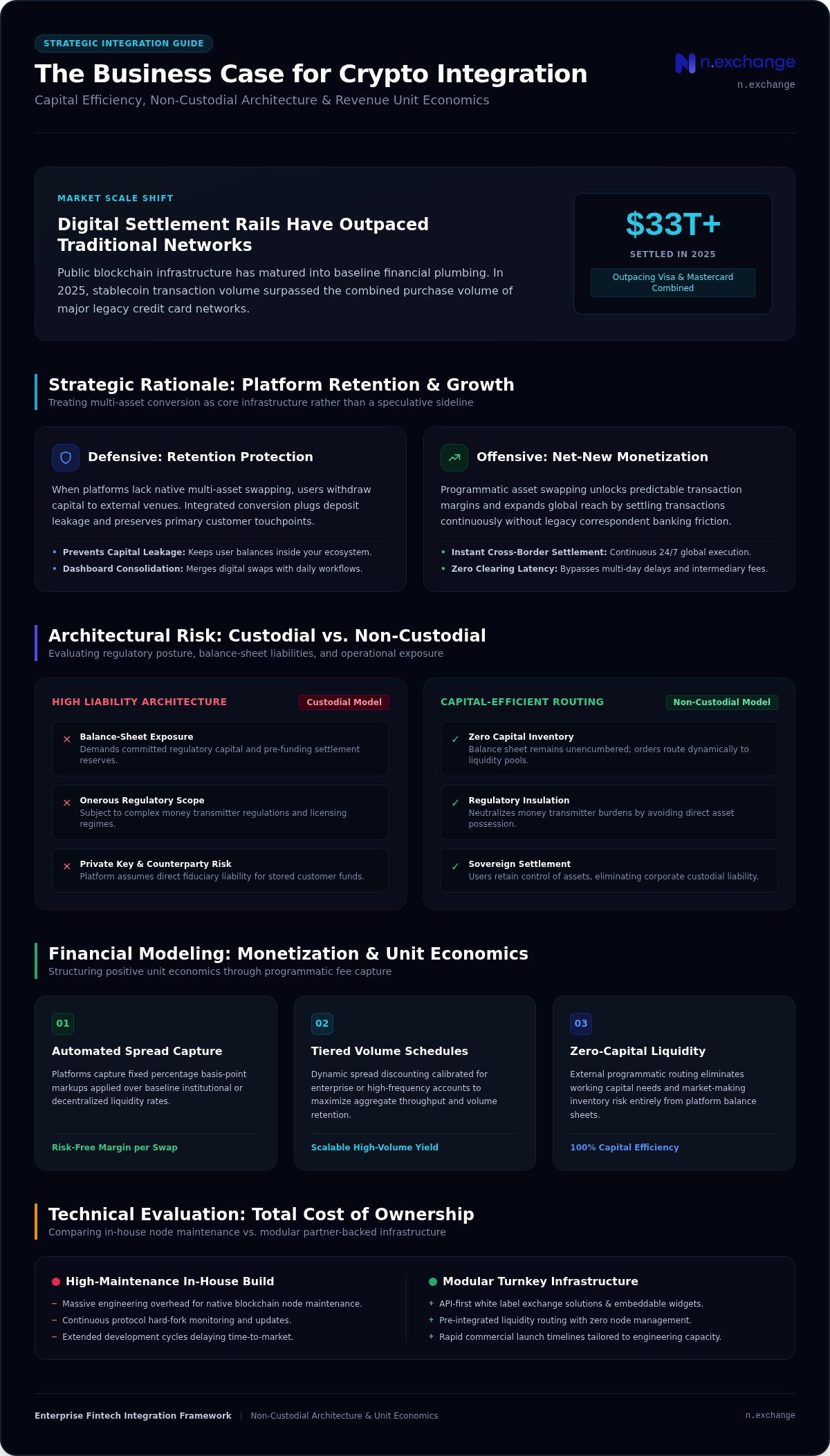
In 2025, public blockchains settled more than $33 trillion in stablecoin transactions, officially outpacing the combined purchase volume of Visa and Mastercard. Yet, formulating a defensible business case for crypto integration often stalls at the leadership level. Executive teams harbor legitimate apprehension regarding complex custodial compliance, balance-sheet liabilities, and the massive engineering overhead of maintaining native blockchain nodes. You shouldn’t have to absorb counterparty risks or overhaul your regulatory posture just to unlock modern settlement rails.
The operational calculus has fundamentally shifted. This guide evaluates the operational, financial, and strategic ROI of integrating non-custodial crypto functionality into your platform. We present a board-ready breakdown of positive unit economics, dissect how API-first architectures neutralize custodial liabilities, and outline how turnkey exchange infrastructure accelerates your time-to-market in 2026.
Key Takeaways
- Build a defensible business case for crypto integration by aligning multi-asset swap capabilities with platform user retention and revenue growth.
- Capture recurring margin through transaction spreads and volume-based markups without introducing balance-sheet exposure or inventory risk.
- Insulate your organization from onerous money transmitter regulations and counterparty liabilities by selecting a non-custodial routing model.
- Quantify the total cost of ownership between high-maintenance in-house builds and modular, partner-backed exchange infrastructure.
- Accelerate commercial launch timelines using turnkey White Label Exchange Solutions or embeddable widgets suited to your technical resources.
Strategic Rationale: Why Modern Platforms Require Digital Asset Infrastructure
Consumer fintechs and B2B SaaS platforms can no longer treat digital assets as a speculative sideline. Modern financial applications face users who demand multi-asset utility directly inside their daily workflows. Consequently, the business case for crypto integration has shifted from capturing trading hype to preserving core platform retention. When your interface lacks native conversion capabilities, users withdraw funds to external venues, severing your primary touchpoint and degrading customer lifetime value.
Executing an integrated strategy acts as both a defensive moat and an offensive growth engine. Defensively, it prevents capital leakage. Offensively, programmatic asset swapping unlocks net-new transaction revenue without altering your fundamental product architecture.
Meeting Shifting Demands in Digital Asset Management
Fragmented financial interfaces create friction. Users increasingly reject maintaining one application for traditional payments and separate third-party exchanges for digital holdings. Understanding the technical divergence in custodial and non-custodial wallet architectures allows software architects to integrate sovereign settlement without absorbing private key liabilities. This approach directly answers user demand for self-directed asset management while keeping engagement consolidated inside your environment.
- Retention protection: Eliminating off-platform asset transfers keeps deposits within your product ecosystem.
- Interface consolidation: Pairing digital asset swaps with existing account dashboards increases daily active usage.
- Demographic alignment: Meeting younger, tech-forward cohorts who expect cross-asset versatility by default.
Expanding Addressable Markets Across Borders
Legacy cross-border payment corridors are notoriously inefficient. Traditional banking rails often impose significant transaction friction through intermediary fees and multi-day settlement delays. In contrast, digital asset rails operate continuously, enabling instant value transfer across borders. Integrating programmatic asset swap tools allows platforms to service an international audience efficiently, settling transactions without the currency drag or clearing latency common to legacy correspondent banking networks.
Building a defensible business case for crypto integration requires recognizing that digital settlement rails have matured into baseline financial plumbing. Platforms that embed direct exchange functionality capture global market share while leaving operational liabilities behind.
Financial Modeling: Monetization Channels, Unit Economics, and ROI
A rigorous financial model separates real enterprise utility from speculative market noise. Building a defensible business case for crypto integration hinges on predictable, recurring cash flows rather than volatile trading windfalls. When structuring non-custodial operations, your platform avoids committing regulatory capital or pre-funding settlement reserves. Instead, every execution operates on programmatic routing, converting user transaction intent into risk-free margin.
Capital efficiency remains the primary commercial advantage. Proprietary market making requires locked treasury reserves and inventory risk. External programmatic routing, by contrast, eliminates working capital requirements entirely while securing reliable transaction yields.
Direct Monetization via Transaction Mechanics
Direct monetization centers on automated spread capture and dynamic fee tiering. Each time a customer initiates a non-custodial crypto swap, the infrastructure locks an execution rate against decentralized or institutional liquidity pools. Platforms capture value through transparent basis-point markups added to the baseline spread.
- Spread capture: Collecting a fixed percentage markup across programmatic asset conversions.
- Tiered volume schedules: Discounting transaction spreads for enterprise or high-frequency accounts to stimulate volume throughput.
- Zero-capital liquidity: Routing orders externally so your balance sheet remains completely unencumbered by crypto inventory.
As detailed in McKinsey’s analysis on the architecture of on-chain money, institutional rails are shifting toward programmable settlement environments where software layers capture value without holding asset balances.
Indirect Value Creation and Retention Lift
Secondary financial returns often outpace direct swap commissions over extended operating cycles. Forcing account holders to bridge capital out to centralized third-party venues produces immediate attrition. Integrating native execution capabilities reverses this dynamic, substantially expanding customer lifetime value while protecting deposit baselines.
Platforms that embed native conversion tools observe measurable lifts in daily session frequency and multi-asset account balances. Reducing transaction friction retains platform capital, turning a previously leaky interface into a consolidated financial hub. Integrating proven solutions like n.exchange infrastructure enables engineering teams to deploy these monetization rails without the expense or distraction of building proprietary clearing networks.
Custodial vs. Non-Custodial Integration: Mitigating Regulatory and Balance-Sheet Risk
Taking custody of customer digital assets introduces severe operational vulnerability. For executive teams evaluating the business case for crypto integration, the decision between custodial storage and non-custodial routing determines whether a launch requires multi-year licensing cycles or a rapid, compliant rollout. Non-custodial architectures decouple transaction facilitation from asset possession. When your platform doesn’t hold customer private keys, you eliminate custodial regulatory exposure while maintaining complete control over the front-end user experience.
The Legal and Compliance Dividend of Non-Custodial Architecture
Custodial operations instantly turn software platforms into regulated financial intermediaries. Safeguarding private keys triggers strict capitalization thresholds, balance-sheet reporting liabilities, and burdensome regulatory scrutiny under frameworks like the EU’s MiCA. Non-custodial integration sidesteps these operational barriers entirely by routing direct, point-to-point swaps between user-controlled endpoints.
Reviewing the compliance benefits of non-custodial exchange models highlights an essential legal distinction: platforms that avoid holding or controlling user assets don’t fall under traditional money transmitter licensing obligations. Instead, they operate as technical communication layers. This structural alignment reflects next-generation value exchange frameworks, treating digital assets as sovereign, user-directed data transfers rather than managed platform liabilities.
Eliminating Systemic Counterparty and Insolvency Risks
Centralized exchange collapses over recent years demonstrated the catastrophic danger of pooling customer balances on third-party balance sheets. When a custodial partner suffers liquidity crises or insolvency, platform funds freeze, exposing the integrating business to reputational ruin and direct civil liability.
Adopting proven strategies for reducing counterparty risk in crypto ensures enterprise balance sheets remain entirely isolated from market volatility. Programmatic, non-custodial execution delivers critical security safeguards:
- Zero balance-sheet exposure: Assets convert programmatically without ever touching your platform’s general ledger.
- Direct cryptographic settlement: Users maintain ownership of their private keys throughout the entire transaction lifecycle.
- Atomic trade execution: Swaps clear directly through distributed liquidity rails, eliminating unsecured intermediary credit risk.
By removing custodial liabilities, leadership teams can present a defensible, board-ready business case for crypto integration that captures digital asset margins without onboarding enterprise risk.
Technical Evaluation: Build vs. Buy, Time-to-Market, and Architecture
Engineering leadership faces a stark trade-off when operationalizing digital asset features. Building proprietary blockchain settlement mechanisms consumes scarce developer resources and introduces endless maintenance debt. Evaluating the business case for crypto integration requires leadership to benchmark total cost of ownership against speed-to-market. While an in-house build commonly demands 12 to 18 months of intensive development, partner-backed architectures deploy in weeks.
To determine technical feasibility, enterprise software teams apply a structured five-step evaluation framework:
- Core competency alignment: Does running validator nodes and routing order flow advance your primary product vision?
- Liquidity access: Can your team secure deep, institutional order routing without tying up treasury reserves?
- Maintenance overhead: Can your engineers manage recurring upstream chain upgrades and client forks?
- Security surface area: Can internal teams audit, patch, and monitor multi-chain smart contracts against continuous exploit vectors?
- Time-to-market constraints: Will a multi-quarter build cycle forfeit your competitive market window?
The Hidden Costs of In-House Blockchain Engineering
Proprietary builds involve substantial ongoing maintenance beyond initial code delivery. Operating multi-chain node infrastructure requires round-the-clock monitoring, continuous RPC load balancing, and dedicated devops attention. Upstream protocol upgrades and unplanned hard forks routinely break proprietary integrations, pulling developers away from core roadmap initiatives.
Third-party smart contract audits and recurring security reviews also impose significant annual expenditures. If a native script fails or an internal node desynchronizes, the platform suffers transaction failures and reputation damage. Offloading these structural layers protects technical focus.
Accelerating Go-to-Market via Modular Integration Models
Modular architectures solve infrastructure friction by decoupling front-end user presentation from complex underlying liquidity management. Engineering teams can select between drop-in embeddable widgets for immediate functionality or headless REST APIs for complete interface customization. Reviewing the developer documentation for a crypto API reveals how standardized endpoints streamline order generation, status polling, and programmatic settlement.
Deploying pre-configured routing engines cuts capital expenditure dramatically while protecting system uptime. Platforms ready to eliminate internal engineering overhead can integrate with n.exchange to deploy institutional liquidity and non-custodial swap execution via a single unified interface.
Focusing internal talent on primary customer-facing value propositions strengthens the strategic business case for crypto integration. Partnering with established routing infrastructure delivers immediate execution velocity while keeping ongoing engineering maintenance predictable.
Executing the Rollout: Deployment Frameworks with n.exchange Infrastructure
Translating strategy into execution requires an implementation model aligned with your technical capacity and risk appetite. Operating since 2016, n.exchange provides institutional-grade, non-custodial exchange infrastructure designed for direct asset conversion without holding customer balances. Solidifying the business case for crypto integration means selecting an integration method that accelerates production timelines while preserving engineering focus.
Organizations can choose from three modular pathways depending on their interface requirements and development cycles:
Tailoring Deployment: APIs, Embeddable Widgets, and Turnkey Platforms
Infrastructure should adapt to your product architecture, not dictate it. Organizations seeking immediate market entry can deploy a fully branded portal using a turnkey White Label Exchange Solution. This path provides a standalone, end-to-end trading interface requiring minimal internal engineering overhead.
For existing platforms seeking tighter UX alignment, two programmatic options deliver native functionality:
- Embeddable Exchange Widget: A modular UI component that embeds non-custodial swap capabilities directly into web applications within minutes, requiring only a few lines of code.
- Exchange API: A high-performance RESTful API enabling development teams to build custom trading flows, handle balance queries, and execute programmatic crypto swaps within proprietary interfaces.
- Turnkey White Label portal: A fully hosted, brandable web exchange that handles liquidity routing and user settlement right out of the box.
Operational Alignment, Testing, and Scalable Execution
Deploying production financial services demands rigorous verification. Engineering teams configure baseline revenue spreads and dynamic fee tiers directly within administrative controls, monetizing transaction flow without handling user custody. Deep order routing guarantees rapid settlement across dozens of layer-1 and layer-2 blockchains without slippage spikes.
Before initiating mainnet traffic, platforms validate routing logic inside staging sandboxes. Sandbox environments simulate execution endpoints, quote generation, and transaction confirmation webhooks under heavy simulated loads. Reviewing the institutional guide to non-custodial crypto exchanges provides engineering leaders with concrete mechanics for maintaining high uptime and zero counterparty insolvency risk.
By leveraging established infrastructure, platform architects execute a defensible business case for crypto integration. You deliver institutional-grade digital asset swaps to your users while offloading liquidity maintenance, node operations, and regulatory custody liabilities.
Executing Your Platform’s Digital Asset Strategy
Presenting a defensible business case for crypto integration requires balancing aggressive revenue targets with strict risk insulation. By adopting a non-custodial architecture, your platform eliminates balance-sheet liabilities, avoids complex money transmitter classifications, and safeguards user retention. You don’t have to lock up corporate treasury capital or commit 18 months of engineering time to capture high-margin swap revenue.
Operating reliably since 2016, n.exchange eliminates custody exposure by routing digital asset swaps directly between user-controlled wallets. Whether your roadmap demands rapid deployment via an Embeddable Exchange Widget, deep native functionality through an Exchange API, or a dedicated White Label Exchange Solution, institutional-grade infrastructure is ready to deploy. Integrate non-custodial crypto infrastructure with n.exchange today to expand your global settlement reach and future-proof your product ecosystem.
Frequently Asked Questions
How does crypto integration generate direct revenue for existing fintech platforms?
Direct revenue stems primarily from programmatic spread capture and transaction fee markups on executed swaps. When users initiate an asset exchange, the platform applies a configurable basis-point margin over the baseline liquidity provider rate. High-velocity transactors and enterprise volume can be monetized via tiered commission schedules. Because routing executes via non-custodial rails, platforms capture this margin without funding working capital reserves or taking inventory price risk on their own balance sheets.
What is the regulatory difference between custodial and non-custodial crypto integration?
The core distinction lies in who controls the cryptographic keys. Custodial integration requires platforms to safeguard user assets, triggering classification as a money transmitter or crypto-asset service provider subject to strict capital reserve and licensing rules. Non-custodial integration treats transactions as technical messaging between user-controlled wallets and decentralized routing rails. This distinction forms a foundational pillar in the business case for crypto integration, allowing platforms to launch legally without managing deposit liabilities.
Why do platforms choose non-custodial architecture over holding user digital assets directly?
Platforms choose non-custodial architecture to completely isolate their balance sheets from counterparty default and insolvency risks. Holding user private keys creates an attractive target for exploits, demands continuous third-party security audits, and exposes corporate entities to massive civil liabilities during market volatility. By facilitating point-to-point swaps where users maintain absolute control of their keys, companies avoid bankruptcy commingling issues and eliminate the fiduciary overhead tied to holding client deposits.
How long does it take to deploy crypto exchange capabilities via API or widget?
Deployment timelines depend on the chosen architectural pathway. Implementing an Embeddable Exchange Widget typically requires less than a week, making it ideal for rapid prototyping or swift market entry. Integrating an enterprise Exchange API into a proprietary user interface generally takes between two and six weeks, including sandbox testing and webhook configuration. In comparison, building custom in-house node routing infrastructure from scratch routinely demands nine to eighteen months of dedicated developer bandwidth.
What ongoing operational maintenance is required after integrating a non-custodial crypto API?
Ongoing operational overhead is virtually negligible compared to running private blockchain nodes. Because the infrastructure provider handles cross-chain liquidity, protocol forks, network upgrades, and node synchronization, your engineering team only maintains standard REST API endpoints and webhook listeners. This minimal maintenance footprint strengthens the executive business case for crypto integration, letting product teams focus entirely on core user interface optimization, customer acquisition, and marketing rather than backend blockchain maintenance.
Can our platform customize branding and transaction fees with a white-label exchange solution?
Yes, turnkey white-label exchange platforms offer deep administrative customization. Operating teams can configure their corporate domain, visual branding, color palettes, and UI styling to ensure a cohesive user experience. In addition, administrative dashboards allow complete control over transaction economics, enabling you to set customized spread markups, establish tiered volume pricing for high-value transactors, and selectively enable supported asset swap pairs to match your platform’s target audience and risk profile.