What if the biggest integration risk isn’t an API endpoint, but the operating model behind it? The questions to ask a crypto API provider depend on what the API does: market data, on-chain access, custody, and crypto swap execution each bring different security and operational requirements. A polished feature list won’t tell you whether a provider’s model fits your product.
Compare capabilities, reliability, and integration effort before committing, but give security and custody equal attention. Find out who controls funds, what your team must build and monitor, and how support works when an issue affects transactions. The answers can shape both your architecture and your operational workload.
This article offers a practical due-diligence framework for technical and business stakeholders. You’ll find questions about security controls, custody, supported use cases, performance, integration, monitoring, and support, along with ways to assess the answers. For products that need crypto-to-crypto swaps, n.exchange offers non-custodial infrastructure through its Exchange API, embeddable widget, and white-label solution, without holding user funds. The goal is to choose a provider model that supports your product without adding infrastructure you don’t need.
Key Takeaways
- Match the API category to your product’s transaction flow before comparing provider capabilities.
- Use the questions to ask a crypto API provider to clarify custody, asset control, and user responsibilities.
- Compare asset and network coverage, integration format, and operational requirements against your product’s needs.
- Assess production readiness by examining latency, rate limits, error handling, status visibility, and ownership of operational tasks.
- Choose an integration model that fits how you plan to deliver swaps, from an API to an embeddable widget or white-label solution.
Questions to Ask a Crypto API Provider Before Choosing an Integration
Start by defining the transaction flow your product needs. An API that returns market prices serves a different purpose from one that routes trades or facilitates crypto-to-crypto swaps. If you compare providers before defining that flow, feature lists may look relevant while describing fundamentally different infrastructure.
This distinction matters for wallets and fintech applications. A product displaying an asset balance or price may need information; a product enabling users to exchange one cryptocurrency for another needs a swap flow. The underlying blockchain technology is shared context, but it doesn’t make every API interchangeable. Provider labels alone won’t explain who initiates a transaction, how assets move, or what your team must operate.
What crypto API are you evaluating?
Classify the API by its role in the user journey, not just by how it’s marketed. Market-data APIs center on asset and market information, such as prices or historical data—the foundation for price tracking and alert tools like coinwink.com. Exchange or trading APIs support trading activity, while swap APIs facilitate exchanges between crypto assets. The exact transaction flow depends on the integration, so establish its scope instead of inferring it from the category name.
Ask whether your product needs information, trading functionality, or a swap experience. If the goal is to let a user exchange one crypto asset for another, a data API may inform the interface but won’t, by itself, provide the swap function. A broad checklist can miss this distinction if it treats data, trading, and swaps as equivalent capabilities.
Which questions should every evaluation answer?
Use a consistent decision framework before comparing provider claims: product fit, custody, capabilities, operations, and implementation. The questions to ask a crypto API provider should establish how its role maps to the user flow, not simply whether it advertises a long list of endpoints.
- Product fit: What action will the end user complete, and what business outcome should the integration enable?
- Custody: Who controls the assets at each stage, and does the provider hold user funds?
- Capabilities: Does the API support the required transaction type, assets, and networks?
- Operations: Which party handles transaction monitoring, exceptions, and dependencies on external services?
- Implementation: What must your team build, maintain, and explain to users?
Map the answers to a simple flow before reviewing feature lists: user action, API function, asset control, transaction initiation, and operational responsibility. For example, a wallet adding crypto-to-crypto swaps should distinguish its user-interface responsibilities from the exchange infrastructure that facilitates the swap. This makes the scope visible early and exposes assumptions a general-purpose API checklist may overlook.
With that baseline, comparisons become more meaningful. Assess providers against the same product requirements while keeping data access, trading, and swap execution in their proper categories. Next, examine how custody and security responsibilities affect the risk of the chosen flow.
Security and Custody Questions That Clarify Crypto API Risk
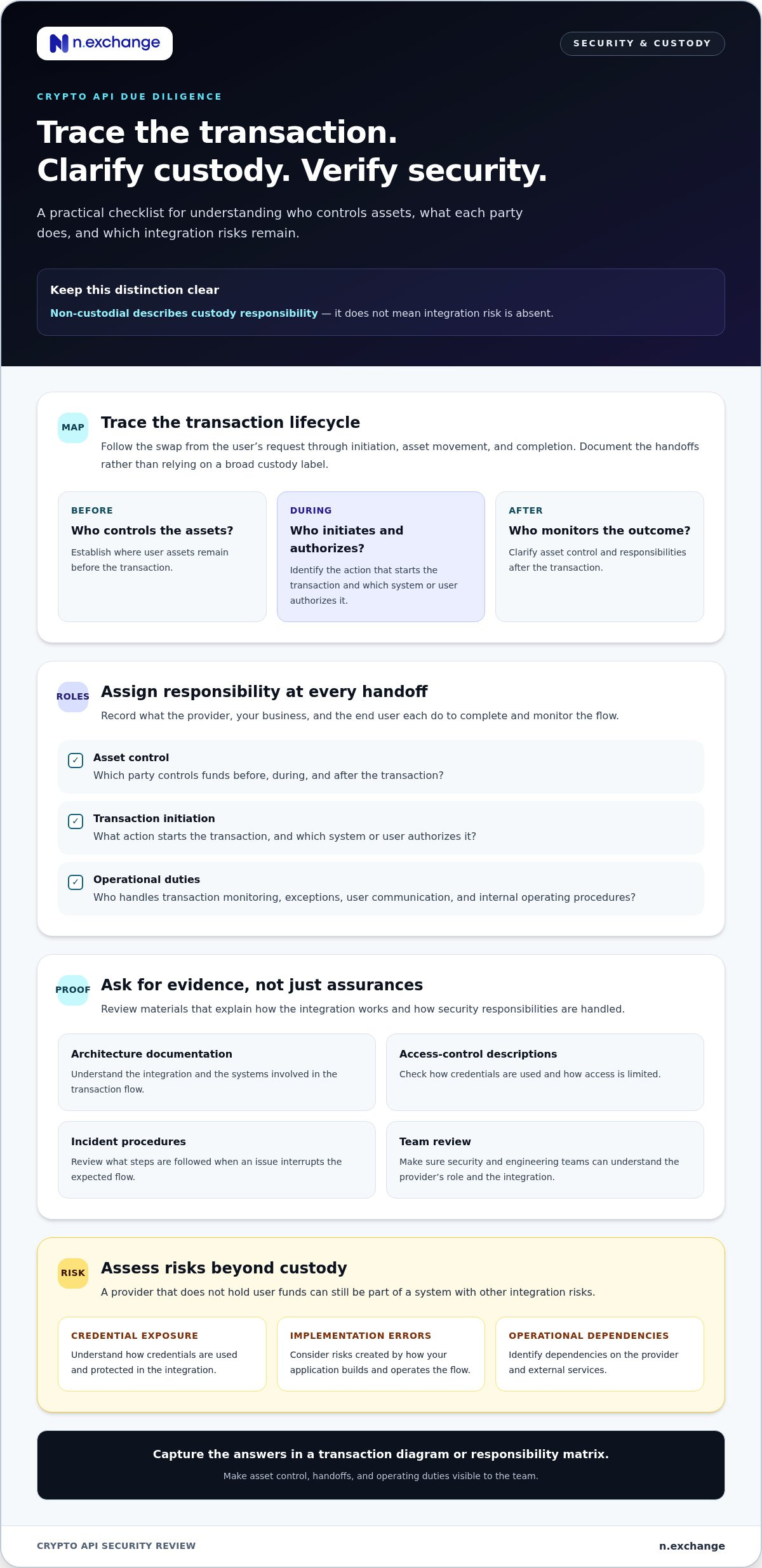
A custody model defines who controls assets, but it doesn’t answer every security question. For a crypto swap, trace the transaction from the user’s request through initiation, asset movement, and completion. At each stage, identify which party acts, what information or permissions are involved, and who is responsible if the expected flow is interrupted.
Non-custodial describes custody responsibility, not the absence of integration risk. A provider that doesn’t hold user funds can still be part of a system with credential exposure, implementation errors, or operational dependencies. Evaluate those risks separately instead of treating custody status as a complete security assessment.
How does the custody model work?
Ask where user assets remain throughout the transaction lifecycle and whether the API provider ever takes custody of them. Clarify how a transaction is initiated and what role the integrating application plays. A wallet, for example, may present the swap experience while separate exchange infrastructure facilitates the crypto-to-crypto transaction. Document the handoffs instead of relying on a broad “non-custodial” label.
- Asset control: Which party controls funds before, during, and after the transaction?
- Transaction initiation: What action starts the transaction, and which system or user authorizes it?
- Responsibilities: What must the provider, your business, and the end user each do to complete and monitor the flow?
Record the answers in a transaction diagram or responsibility matrix. This helps your team distinguish the provider’s role from application security, user communication, and internal operating procedures.
What security evidence should teams assess?
Use the questions to ask a crypto API provider to request evidence about the integration, not just general assurances. Review architecture documentation, access-control descriptions, and incident procedures. Your security and engineering teams should be able to understand how credentials are used, how access is limited, and what steps apply if a credential or transaction flow is compromised.
- How does the integration authenticate requests, and where should credentials be stored?
- Can permissions be scoped to the functions the application needs?
- How are access changes, credential exposure, and suspected incidents handled?
- What incident communication and response responsibilities belong to each party?
Separate documented controls from assumptions. Establish how each documented control applies to your integration, and don’t treat an undocumented control as present. Then map your own safeguards, including credential handling, access governance, transaction review, and escalation ownership. Clear boundaries reduce gaps between provider processes and your production procedures.
For teams assessing a non-custodial swap model, n.exchange’s crypto swap infrastructure facilitates direct crypto-to-crypto exchanges without holding user funds. Apply the same custody and responsibility questions to understand how that model fits your application and operating plan.
Compare Crypto API Capabilities, Coverage, and Integration Models
Once the custody boundaries are clear, test whether the integration supports the user journey you intend to deliver. A provider’s broad asset list doesn’t prove that every asset pair, network, or transaction path is supported. Define the required flow first, then compare provider capabilities against it.
Does the API support the product’s required transaction flow?
Specify the source asset, destination asset, and networks involved in each intended transaction. Then map how quotes, transaction instructions, and status information fit into the user journey. For example, a wallet offering swaps needs to understand how a user selects a pair, receives a quote, proceeds with the exchange, and sees what happens next. Assess the complete flow, not just a headline asset count.
Use a comparison matrix to keep delivery models and API categories distinct. Treat each row as a due-diligence prompt, not an assumption about what a provider supports.
| Comparison area | API integration | Embeddable widget | White-label solution |
|---|---|---|---|
| Scope | Connect swap functionality to the application | Present an embedded exchange experience | Support a branded exchange service |
| Integration format | Application-level integration | Embedded interface | White-label infrastructure |
| Flow to assess | How the application handles the swap journey | How the embedded experience fits the product | How the branded service fits the business model |
| Operational fit | Assess development and ongoing integration responsibilities | Assess interface fit and responsibilities around the embedded experience | Assess the scope of the exchange service and its operational ownership |
For every format, verify whether the required source and destination assets are supported on the networks your product needs. Clarify what quote, instruction, and status details are available for the intended flow. Don’t infer coverage or operational behavior from a general product description.
Should you integrate an API, widget, or white-label solution?
Choose the format based on the product experience and the level of application control you need. An API suits a team building swap functionality directly into its application. An embeddable widget may fit when the priority is incorporating an exchange experience without building the entire interface. A white-label solution is relevant when the goal is a branded exchange service.
These models aren’t interchangeable shortcuts. An API gives the product team an application-level integration to plan and maintain. A widget centers on an embedded experience, while a white-label model supports delivering an exchange under the business’s brand. Compare the product control, implementation effort, and operational responsibilities each requires.
For fintech teams considering a non-custodial model, this non-custodial crypto API guide provides additional context. The most useful questions to ask a crypto API provider are grounded in your required assets, networks, transaction flow, and delivery format.
A Crypto API Provider Due-Diligence Checklist for Production Readiness
Production readiness involves more than a successful demo. Test the expected transaction flow, understand how failures surface, and decide who owns each operational task. Use this sequence to turn the questions to ask a crypto API provider into a practical review that engineering, product, and operations can complete together.
- Define requirements. Document the intended user journey, transaction types, required assets and networks, and expected volume patterns. Identify the latency your product can tolerate and ask what response times the integration is designed to support.
- Review evidence. Examine integration documentation, security materials, and published service information. Ask whether rate limits apply, how they’re communicated, and what happens when requests exceed them.
- Test flows. In a controlled environment, test normal transactions alongside rejected requests, timeouts, edge cases, and incomplete transactions. Include reconciliation so your team can compare application records with transaction outcomes.
- Plan operations. Ask how errors are returned, what status visibility is available, and how incidents are communicated. Establish what your team must implement rather than assuming the API provides a particular monitoring or alerting feature.
- Document ownership. Record responsibility for investigation, escalation, user communication, and reconciliation. Assign internal owners and provider contacts for each operational scenario before launch.
What should teams validate before launch?
Run representative test cases from the user’s initial action through the final state shown in your product. Include expected behavior for a successful flow, a delayed response, a rejected request, and a transaction that remains incomplete. Verify that the interface doesn’t present an uncertain state as a completed transaction.
For each case, document the application’s response, the responsible team, and the escalation path. Define user-facing error messages that explain what happened without implying a result your system can’t verify. The crypto API integration handbook offers further implementation context for teams preparing their integration.
How should reliability and support be evaluated?
Review the provider’s service information and incident communication processes. Ask how operational issues are reported, which support channels apply to the integration, and who owns escalation on both sides. Clarify how your team should respond if transaction status is delayed or unavailable, and how to reconcile that status before updating the user.
Include these dependencies in your broader crypto counterparty-risk assessment. If you’re preparing a non-custodial swap integration, explore n.exchange’s crypto exchange infrastructure as part of your production-readiness review.
How n.exchange Fits a Non-Custodial Crypto Swap Product
After defining the transaction flow, custody boundaries, and production requirements, assess whether the infrastructure model fits your product. n.exchange provides non-custodial cryptocurrency exchange infrastructure for direct crypto-to-crypto swaps through its Exchange API, embeddable exchange widget, and white-label solutions. The platform facilitates swaps without holding user funds and focuses on high-liquidity crypto-to-crypto trading.
This model is relevant when a wallet or fintech application aims to add crypto swap functionality without making custody the provider’s role. It isn’t a blanket security guarantee or a substitute for integration diligence. Use your evaluation findings to compare the product experience, responsibilities, and delivery format each option supports.
When does n.exchange’s API model fit?
The Exchange API lets applications integrate crypto swap functionality into their products. It may fit a team building its own application-level experience, where the swap flow is part of a broader wallet or fintech journey. Assess the fit against your defined source and destination assets, networks, transaction steps, and operating plan. The infrastructure is non-custodial and focused on crypto-to-crypto trading.
When might an embedded or white-label option fit?
An embeddable widget suits a product that needs an integrated exchange experience, while a white-label solution enables businesses to deploy a branded exchange. These formats address different product goals: adding exchange functionality to an existing experience versus offering an exchange under your brand. Compare each with your desired interface, implementation approach, and ownership responsibilities.
The distinction is useful for product planning. A team seeking direct control over its application’s swap journey may evaluate the API; one prioritizing an embedded exchange experience may consider the widget; and a business building a branded exchange service may assess the white-label model. The right fit depends on the product you’re delivering, not the number of available integration formats.
Keep the same diligence standards in place. Confirm that the intended assets, networks, and transaction flow align with your requirements, then map operational ownership and integration tasks before making a decision. The questions to ask a crypto API provider remain relevant even when its core model matches your use case. Architecture fit narrows the choice; it doesn’t replace implementation planning.
For teams evaluating non-custodial crypto swap infrastructure, explore n.exchange infrastructure and assess how the API, widget, or white-label solution aligns with your product requirements.
Turn Due Diligence Into Your Next Step
Make your evaluation actionable by turning the answers into a decision record: what your product needs, which trade-offs the team accepts, and who owns each implementation and operational responsibility. This gives engineering, product, security, and business stakeholders a shared basis for moving forward instead of leaving key assumptions scattered across meetings and documentation.
The questions to ask a crypto API provider are most valuable when they lead to a clear decision about product fit and a realistic launch plan. Use your requirements to assess whether an integration supports the experience you intend to build, then define validation steps with the teams responsible for delivery.
If non-custodial crypto swap infrastructure fits your roadmap, explore n.exchange crypto infrastructure to evaluate your integration path. A disciplined decision gives your team a stronger foundation for building with confidence.
Frequently Asked Questions
What questions should I ask a crypto API provider?
Start by asking whether the API supports your product’s intended user journey, then clarify its scope, custody model, asset and network coverage, implementation needs, operational responsibilities, and support processes. The questions to ask a crypto API provider should reflect real use cases. For example, trace what a user sees after selecting a swap if a transaction is delayed. Record answers in a shared decision log so engineering, product, and risk teams work from the same assumptions.
How do I evaluate the security of a crypto API?
Review the provider’s architecture and security documentation, then assess how your integration handles credentials, permissions, transaction authorization, and incidents. For example, trace where an API credential is stored, which application components can access it, and how your team would respond to suspected exposure. Test your own application’s error and access-control behavior as well. Security depends on the full system, so evaluate provider design alongside your implementation and operating procedures.
Does non-custodial mean a crypto API is risk-free?
No. Non-custodial describes an asset-control arrangement, not the removal of every technical or operational risk. A user may still encounter an unclear transaction state, an integration error, or a delay in your application’s display. Consider how your product will distinguish pending, failed, and completed outcomes, and what it will tell the user in each case. Review custody design together with credential protection, internal controls, and incident readiness.
What is the difference between a crypto exchange API and a market data API?
A market data API retrieves information, such as asset prices or market activity, while an exchange API connects an application with trading or exchange-related functionality. The distinction matters in implementation: returning a price doesn’t itself enable a user to exchange assets. Provider terminology can vary, so compare actual endpoint behavior with the transaction flow your product needs. For a swap experience, determine whether the API supports the exchange action rather than only supplying related data.
How should a team test a crypto API before production?
Test representative user journeys in a controlled environment, including success, invalid input, timeouts, rejected requests, and incomplete states. Add a retry scenario: confirm how your application avoids showing duplicate actions or treating an unverified result as final. Define expected application behavior for each case, including the user-facing message and the team responsible for investigation. A successful demonstration alone won’t show how the integration behaves under failure conditions.
What should I look for in crypto API documentation?
Look for clear descriptions of authentication, request and response formats, error behavior, transaction states, and implementation prerequisites. Then check whether the examples match your intended use case. For instance, a team building a swap flow needs enough detail to understand what the application receives at each relevant stage, not just a basic connection example. Note unclear terms or missing steps and resolve them before they become development assumptions.
How do I compare crypto API pricing models?
Compare the provider’s published commercial terms by service scope and billing conditions, not by a single headline figure. Identify how charges are calculated, which activities are included, and whether usage levels, minimums, or overages affect the total. Consider how the model might change as your product grows. Keep the comparison separate from technical scoring so a lower quoted amount doesn’t obscure differences in capabilities, responsibilities, or integration effort.