Capacity is a design decision, not a late-stage fix. Scalable crypto exchange infrastructure comes from aligning liquidity planning with matching-engine capacity, API throughput, and continuous performance measurement. Use sub-50-millisecond API responses and uptime at or above 99.9% as reference benchmarks, then load-test the system against expected demand peaks.
As an exchange grows, pressure can emerge in several areas: order execution, market-data delivery, or the depth available to fill trades. User counts alone won’t reveal which component is becoming a constraint. Measure performance to identify bottlenecks and expand capacity where it matters.
This article explains how to scale a crypto exchange business through liquidity planning, faster matching, and efficient APIs. It also covers the performance metrics that help assess readiness, so you can connect infrastructure decisions to the trading experience your platform needs to support.
Key Takeaways
- Plan liquidity around the assets and trading pairs you support, and assess how external liquidity sources could strengthen execution.
- Build security controls, including multi-signature authorization, into your exchange’s growth plan.
- Measure matching-engine and API performance under load to identify bottlenecks before demand spikes.
- Assess how each added cryptocurrency, trading pair, or tokenized asset affects operational and infrastructure capacity.
- Track response times, uptime, and traffic patterns to guide capacity planning and prioritize improvements.
1. Liquidity management and market-maker incentives
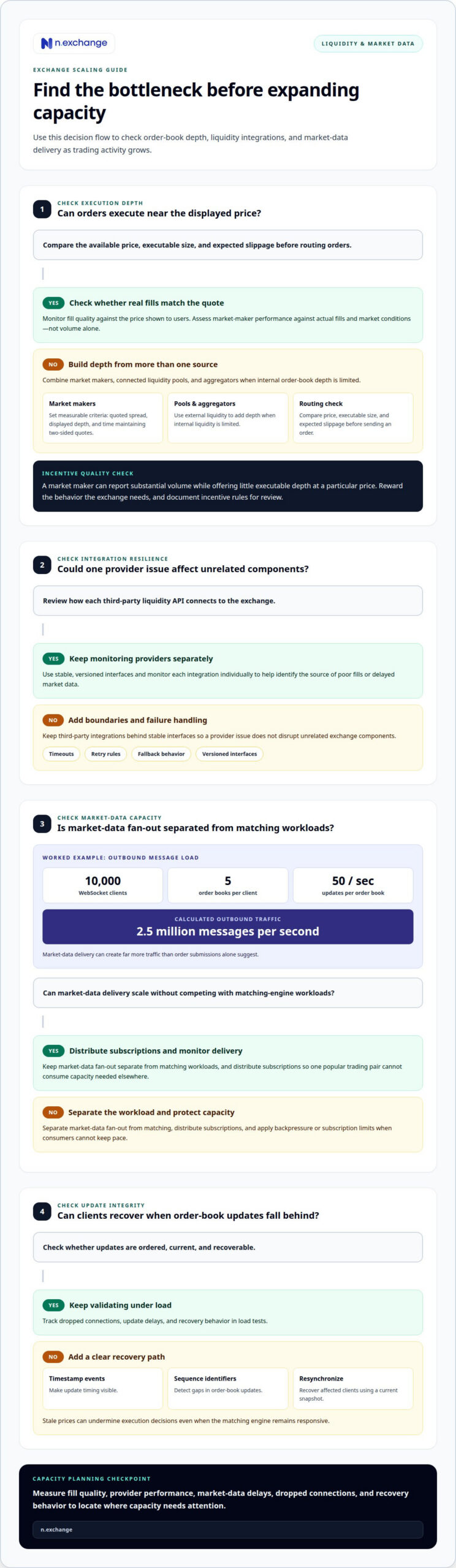
Exchange infrastructure should connect internal order books with external liquidity sources, then monitor fill quality and market-data delivery. Keep third-party integrations behind stable interfaces so an issue with one provider does not disrupt unrelated exchange components.
Liquidity determines whether orders can execute near the displayed price. Crypto exchange trading across spot and derivatives markets exceeded $79 trillion in 2025. The cryptocurrency exchange platform market is expected to grow at a compound annual growth rate of 25.6% from 2025 to 2026, while the global platform market is projected to grow at 26.1% annually through 2030. These figures describe market expansion, not guaranteed demand for an individual exchange.
Build depth through a combination of market makers, connected liquidity pools, and aggregators. Market makers place bids and asks to help maintain an order book as trading conditions change. External pools or aggregators can add liquidity when internal depth is limited. Before routing orders, compare the available price, executable size, and expected slippage. Then check whether execution matches the quote shown to the user.
Market-maker incentives should reward the behavior your exchange needs. Set measurable criteria, such as quoted spread, displayed depth, and time spent maintaining two-sided quotes. Assess these measures against actual fills and market conditions rather than rewarding volume alone. A market maker may report substantial volume while offering little executable depth at a particular price. Document incentive rules and review them through appropriate regulatory and operational processes.
Market data creates a separate scaling challenge. In a worked example, 10,000 WebSocket clients receiving five order books updated 50 times per second generate 2.5 million outbound messages per second. This is far more traffic than order submissions alone suggest. Separate market-data fan-out from matching workloads, and distribute subscriptions so one popular trading pair cannot consume the capacity needed elsewhere.
Reliable, up-to-date market data depends on how updates are handled. Add timestamps and sequence identifiers to order-book events, detect gaps, and resynchronize affected clients using a current snapshot. Apply backpressure or subscription limits when consumers cannot keep pace. Stale prices can undermine execution decisions even when the matching engine remains responsive. Track dropped connections, update delays, and recovery behavior in load tests.
For third-party APIs, set timeouts, retry rules, and fallback behavior before connecting a liquidity provider. Version interfaces and monitor each integration separately. This helps pinpoint whether poor fills or delayed market data come from the exchange, an aggregator, or a liquidity source.
2. How to Scale Crypto Exchange Business?
As traffic and order volume grow, so do security demands. Build controls into the architecture before expanding access, assets, or server capacity. Separate signing authority from routine application operations, and require independent approval for sensitive withdrawals. These measures reduce reliance on a single credential and create a reviewable execution path.
Multi-signature authorization requires several approved signers before a wallet transaction can proceed. A 3-of-5 setup, for example, requires three approvals from five authorized signers; a 5-of-7 setup requires five. Assign signers across distinct roles and protect their credentials separately. Multi-signature approvals can take 30-60 seconds, so account for that delay in withdrawal procedures and user communications.
Cold storage and limited hot-wallet exposure can reduce the potential impact of a compromised online system. A 95% cold-wallet and 5% hot-wallet allocation is one planning model, not a universal operating rule. Set the allocation according to withdrawal activity, asset movements, and recovery procedures. Keep authorization records and test recovery processes so the security design remains usable during an incident.
Layer operational controls around wallet safeguards. Use authentication and authorization to verify user and service identities, then limit permissions to necessary actions. Firewalls can filter unwanted traffic, while audit logs record account changes, administrative access, and order-related events. Apply security updates through a controlled release process, with testing and rollback plans to limit disruption to execution.
Fraud prevention depends on combining transaction monitoring with clear review paths. Flag unusual access patterns, changes to withdrawal details, and activity that differs from an account’s established behavior. Route higher-risk actions for additional scrutiny, and preserve event records for investigation. Approximately 39% of cryptocurrency exchanges experienced a data breach in 2024, underscoring the need to treat monitoring and incident response as ongoing operations.
Institutional readiness also requires documented controls and measurable service expectations. Define incident escalation procedures, how service interruptions will be communicated, and recovery steps for critical systems. Align service-level commitments with actual monitoring and support processes. An SLA is useful only when teams can measure and report against it. The European Union identifies KYC, AML, and GDPR as relevant compliance considerations, so map applicable obligations to onboarding, data handling, and transaction oversight.
For businesses planning an exchange implementation, exchange infrastructure options can provide a starting point for evaluating how security boundaries and operating workflows fit together.
Global exchanges must meet applicable KYC and AML requirements, aligning practices with FATF guidelines and local cryptocurrency laws. The European Union identifies KYC, AML, and GDPR as relevant considerations. Two-factor authentication is increasingly standard, and can include hardware-based methods.
3. High-throughput matching engines and low-latency APIs
Scalable crypto exchange infrastructure combines a matching engine, API gateway, risk controls, persistent storage, and monitoring. These components coordinate order intake, validation, matching, and trade reporting. Keep their responsibilities distinct so a market-data workload doesn’t block order execution. This separation helps teams pinpoint bottlenecks as trading activity rises.
The matching engine validates orders against market rules, updates the relevant order book, and publishes execution results. Its throughput must reflect both ordinary trading and sudden bursts. One capacity example estimates normal peak order flow at about 10,300 messages per second. A tenfold increase during a crash-related surge would require handling about 103,000 messages per second.
Use those estimates to shape a test plan, not as a universal capacity promise. Load testing at 10 times expected peak order flow can expose limits in matching, database writes, and downstream event processing. A worked example sets a target near 200,000 messages per second with 2x safety headroom. Test order placement, cancellation, and execution together, since each consumes resources differently.
Throughput alone won’t reveal user-facing delays. A scalable crypto exchange infrastructure should target order execution under 100 milliseconds, then track latency distributions under realistic workloads. Average response time can hide slow outliers, so monitor tail latency across order submission, validation, matching, and confirmation. When execution time rises from 50 milliseconds to 3-5 seconds under high load, users may receive delayed feedback during fast-moving markets.
Low-latency APIs need efficient request handling and predictable failure behavior. Validate inputs at the gateway, apply rate limits, and return clear errors when capacity is constrained. Use asynchronous queues for work that need not block an order response, while preserving operation order wherever trading state depends on it. Measure API response time alongside engine throughput to locate delays before or after matching.
Real-time risk management belongs close to order processing. Pre-trade checks can evaluate available balances, position limits, and account permissions before an order reaches the engine. A liquidation engine should use current position and market data, then coordinate actions through defined workflows. Test risk checks under peak order traffic: a fast matching engine cannot compensate for delayed risk decisions.
Monitor incoming orders, rejected requests, matching, queue depth, database persistence, and execution confirmations separately. Controlled load tests can reproduce saturation and expose bottlenecks before production traffic reaches them. For scalable crypto exchange infrastructure, use test results to identify which component needs optimization or additional resources, then retest after each change.
4. Why Is Scalability Important for Your Crypto Exchange?
Scalability lets a platform expand its assets and trading pairs without overloading shared services. Each new cryptocurrency can require blockchain connectivity, transaction validation, market data, and operational monitoring. Add assets through a controlled process: test network interactions, configure pair rules, and verify transaction handling before enabling trading.
Tokenized real-world assets add another layer of platform requirements. Trading them may depend on asset-specific data, transfer rules, and market availability. Keep those workflows distinct from ordinary crypto transactions so updates to one asset type don’t disrupt unrelated markets. This modular approach also makes each new integration easier to assess.
User growth affects more than account storage. A platform expanding from 10,000 to 100,000 users must plan for concurrent sessions, API requests, market-data delivery, and order activity. Track those workloads separately, then scale the constrained service instead of increasing every server’s capacity. This helps direct resources toward actual demand.
Infrastructure costs depend on architecture, supported assets, security controls, cloud deployment, and operating workload. Project costs are provided after a quote request. Key cost drivers include development, integrations, hosting, monitoring, and ongoing maintenance.
Cloud-native deployment supports auto-scaling and broad reach. Microservices let components such as the trading engine, wallet, and user management scale independently. Combine horizontal scaling, which adds servers or nodes, with vertical scaling, which upgrades existing capacity. Load balancers distribute requests across available servers as traffic changes.
Derivatives and perpetual trading require capacity planning beyond spot-market order handling. Futures and perpetuals contributed roughly $62 trillion of crypto exchange trading in 2025. Their activity can increase demand on matching, position tracking, and risk workflows. Design these components to scale independently, and test how bursts affect shared infrastructure.
AI-assisted trading workflows can add requests and automated order activity. Keep user controls clear: define permissions for automated actions, provide ways to pause or revoke access, and record relevant activity for review. Monitor how these workflows affect transaction volume and matching-engine demand, especially during market spikes.
Plan for surges using realistic growth scenarios, not only average daily activity. A startup onboarding 50,000 new users in six months, for example, needs capacity for account creation and increased platform traffic. Set thresholds for scaling, monitor service performance during updates, and verify that new capacity handles transactions without slowing unrelated functions.
Realistic load tests across peak and ordinary conditions help expose bottlenecks before they affect customers. Crypto exchanges read and process millions of transactions every day. Integrating multiple blockchains can enable an exchange to offer a wider range of tradable cryptocurrencies and support scalability as transaction volumes grow. Across the crypto ecosystem, thousands of cryptocurrencies are available. During the 2021 bull run, Binance and Kraken experienced server overloads as users rushed to trade. Reviewing those pressure points can inform capacity planning and help keep access reliable when activity rises.
5. Exchange scalability metrics and performance benchmarks
Scalability needs observable targets, not a single headline throughput figure. Track API response time, order-processing latency, successful execution rate, and uptime as separate measures. A sub-50-millisecond API response time is a useful benchmark, but it should reflect sustained performance under representative traffic, not an isolated test. Record results across normal activity and peak periods to see how capacity changes.
How do leading crypto exchange infrastructure providers compare? Assess them using the same workload, measurement window, and definitions for response time, trading availability, and successful matching. Published capacity claims are hard to compare without knowing whether they include order validation, persistence, and downstream updates.
Uptime and trading availability describe related but distinct outcomes. A platform may respond to general requests while its matching function is unavailable. Use uptime at or above 99.9% as an infrastructure benchmark, and assess 99.95% trading availability per year as a separate trading-service benchmark. Define which services count, how maintenance is measured, and how incidents affect each calculation.
Measure more than average latency. Track API response and execution-confirmation percentiles, then compare them during load tests and production peaks. A rising tail can reveal queue buildup even when typical requests remain fast. Pair latency with error rates, rejected orders, and timeouts to locate constraints in the API layer, matching, or persistence.
Reliability also depends on monitoring dependencies. Track database write delays, message-queue depth, server saturation, and blockchain transaction processing separately. For example, a growing queue alongside stable API responses may point to pressure in downstream processing. Set alerts against service objectives, and review incidents using dashboards that show affected components and active workloads.
Wallet and market-data services need their own indicators, rather than being hidden in a single platform-wide score. Track processing delays, failed operations, and recovery behavior for each critical workflow. Establish a baseline, change one capacity variable at a time, and compare results before and after deployment updates. This gives engineering teams evidence to prioritize the next improvement.
Turn these benchmarks into a repeatable operating process: set targets, test realistic workloads, inspect bottlenecks, and retest after changes. Explore exchange API options as you map performance requirements to your platform architecture.
N.exchange: Non-custodial Crypto Exchange
n.exchange provides a non-custodial crypto exchange for businesses that want to support direct digital asset swaps. If you’re building a trading service, its Exchange API and White Label Exchange Solution let you integrate exchange functionality or launch a branded platform. For an existing website or application, the Embeddable Exchange Widget lets you add exchange functionality to the user experience.
The right option depends on your operating model: choose the API to integrate exchange functionality, the white-label solution to launch a trading service, or the widget to embed swaps in a digital product. Each option connects infrastructure planning to a defined implementation path.
Visit n.exchange to explore its exchange solutions and find the option that fits your platform.
Make Capacity a Continuous Practice
Growth planning works best when infrastructure decisions support product and operating priorities. Before the next expansion, define who owns capacity thresholds, how changes are reviewed, and what evidence is required before a release. This makes scalable crypto exchange infrastructure an ongoing discipline, not a one-time build goal.
Start by identifying the next capability your business plans to support, then map its dependencies and operational requirements. Use that assessment to guide architecture decisions and keep development aligned with the service you want to deliver. A focused plan helps prioritize improvements without treating every component as an urgent rebuild.
n.exchange can help you explore an implementation path for your exchange plans. Discuss your exchange plans with n.exchange, and take the next step with a clear view of your platform’s direction.
Frequently Asked Questions
How to Scale Crypto Exchange Business?
Scale in stages, matching each expansion to a defined business need. Before adding a new market, for example, map dependencies across customer onboarding, asset support, trading, and operations. Assign service ownership and deployment procedures to each component, then expand after testing the full workflow. This helps prevent product growth from creating disconnected processes that teams cannot support consistently.
Why Scaling a Crypto Exchange Is Critical for Long-Term Success?
Scaling helps an exchange adapt as user expectations, supported markets, and operating demands change. A platform that can expand or adjust individual components has more room to evolve than one built on fixed assumptions. It also helps teams plan upgrades deliberately, rather than waiting for capacity or operational constraints to disrupt core services. Long-term success depends on making growth manageable, not simply increasing activity.
Why Is Scalability Important for Your Crypto Exchange?
Scalability matters because platforms must accommodate product changes as well as increased usage. Adding a token, for instance, can affect asset handling, market configuration, customer information, and internal support procedures. Reviewing these dependencies before launch helps teams understand the full operational impact. Scalability also supports orderly maintenance, so updates to one function need not require unnecessary changes across the platform.
How should a crypto exchange architecture scale for high throughput and low latency?
Keep latency-sensitive order processing separate from tasks that can run asynchronously, such as reporting. Define clear interfaces between services, and use idempotency controls to make order handling resilient to duplicate requests. Measure performance across the full request path, from API entry to confirmation. This reveals delays caused by dependencies rather than attributing every slowdown to the matching component.
What are the best matching engines and order book designs for crypto exchanges?
The best design depends on market structure, expected order patterns, consistency needs, and operational complexity. Compare approaches by how they preserve price-time priority, process cancellations, recover state, and distribute updates to subscribers. A centralized order book can suit markets that need a consolidated view, while separate books can isolate pairs. Test the selected design with representative order sequences and failure scenarios before launch.
What are the main security and operational risks in scaling a cryptocurrency exchange?
Scaling can increase exposure to compromised credentials, excessive service permissions, integration failures, and gaps in incident visibility. Operational risks include failed deployments, inconsistent data between services, and backlogs that delay customer actions. Assign an owner to each critical workflow, log administrative and system events, and rehearse recovery procedures. Review access when teams or integrations change to keep permissions aligned with current responsibilities.