
In 2026, the primary metric for evaluating white label providers is no longer feature count, but the elimination of counterparty risk through non-custodial architecture. You’ve likely observed how custodial failures and shifting regulatory goalposts, such as the SEC’s Regulation Crypto Assets, have redefined what it means to be a reliable market participant. When you’re evaluating white label exchange providers, the standard checklist of UI skins and coin listings is no longer enough to protect your business from systemic operational risks.
This guide provides the strategic framework to master the technical and operational criteria required to select a crypto exchange infrastructure partner that minimizes risk and maximizes scalability. You’ll learn how to secure a non-custodial infrastructure that scales, maintain full brand control through robust APIs, and leverage institutional-grade liquidity to reduce your time-to-market. We’ll examine the structural integrity and regulatory resilience your enterprise demands to succeed in the current digital asset environment.
Key Takeaways
- Understand the shift from basic UI wrappers to modular liquidity engines when evaluating white label exchange providers to ensure long-term operational stability.
- Distinguish between custodial and non-custodial architectures to eliminate counterparty risk and avoid the security vulnerabilities of centralized honeypots.
- Prioritize aggregated liquidity models to minimize slippage and provide the depth required for institutional-grade trading environments.
- Navigate the 2026 US regulatory landscape by leveraging the structural compliance benefits inherent in non-custodial exchange frameworks.
- Reduce time-to-market by deploying a robust, API-driven infrastructure that allows for full brand control and seamless integration into existing apps.
The 2026 Landscape: Why Evaluation Criteria Have Shifted
The digital asset market in 2026 has transitioned from a phase of rapid experimentation to one of structural discipline. Previously, businesses sought quick entry through turnkey clones. Today, the process of evaluating white label exchange providers requires a deeper audit of underlying software architecture. A standard white-label product that merely offers a visual skin over a generic engine is no longer viable for institutional-grade operations.
Market saturation has led to a proliferation of “skin-deep” UI wrappers that lack robust, integrated liquidity engines. These superficial solutions often mask significant technical debt that only surfaces during high-volatility events or periods of rapid user acquisition. While “speed to market” was once the primary selling point for startups, “security at scale” has become the mandatory priority for established firms and new entrants alike. The financial and reputational cost of switching providers after a botched initial launch is prohibitive. It often involves complex data migrations, user churn, and a complete rebuild of the integration layer, which can stall a business for months.
The Institutional Shift Toward Transparency
User expectations have shifted from simple convenience to verifiable safety. The decline of “black box” exchange providers, where fund management and execution logic remain obscured, is a direct result of increased market scrutiny. Modern fintech partnerships now require verifiable systems that prove operational integrity at every step. Transparency isn’t an optional feature. It’s a mandatory requirement for regulatory approval and institutional partnership. Providers must now demonstrate exactly how they handle assets and execute trades without relying on opaque internal ledgers that create systemic risk.
Defining Your Business Objectives
Strategic success begins with a clear distinction between a streamlined swap service and a full-featured trading platform. Attempting to build custom infrastructure from the ground up often results in unmanageable technical debt, making a licensed model the logical path for most. For modern firms, aligning with the benefits of non-custodial architecture ensures long-term growth by removing the liability of fund custody. This architectural choice directly impacts your regulatory footprint and operational risk profile when evaluating white label exchange providers for a 2026 launch. You must decide if your goal is to manage a complex treasury or simply to facilitate seamless asset exchange.
Core Technical Architecture: Custodial vs. Non-Custodial
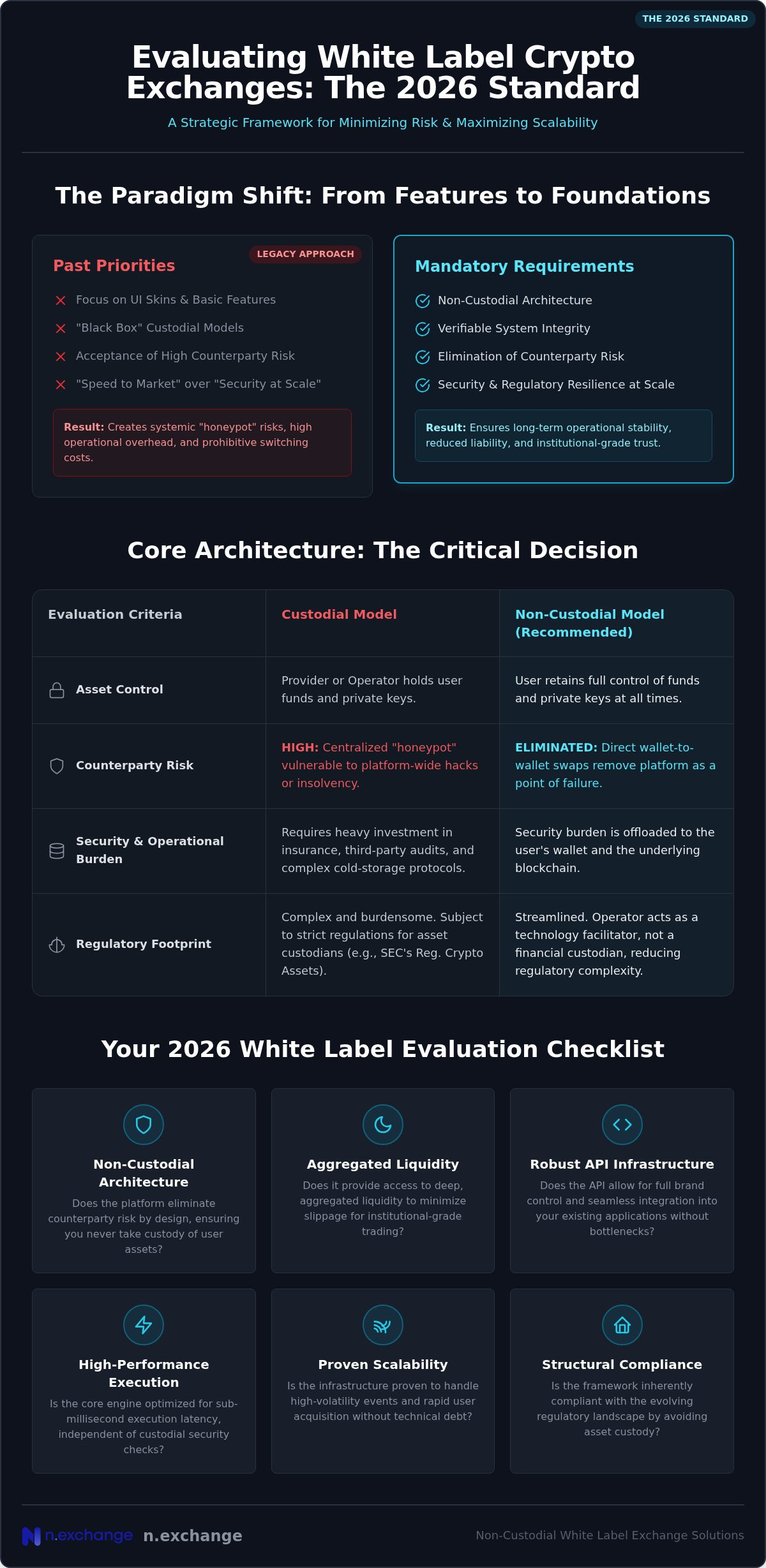
The determination of asset custody is the most critical decision when evaluating white label exchange providers. This architectural choice dictates your entire risk profile, regulatory burden, and operational overhead. In a custodial model, the provider or the operator holds the private keys. This centralizes control but creates a systemic “honeypot” risk. To mitigate this, custodial operators must invest heavily in insurance, frequent third-party audits, and complex cold-storage protocols that can slow down internal processes.
Non-custodial white labels eliminate the need for internal fund management. Facilitating direct execution without taking control of user assets removes the primary target for platform-wide hacks. This structural advantage is a primary reason for evaluating white label exchange providers that prioritize non-custodial tech in the 2026 market. Modern non-custodial systems utilize high-performance APIs to ensure execution speed remains competitive with centralized counterparts, as throughput is no longer bottlenecked by the security requirements of a central vault.
Performance benchmarks in 2026 focus on API response times and order execution latency. High-performance solutions achieve sub-millisecond execution by offloading the security burden to the blockchain and the user wallet. This allows the core engine to focus entirely on matching and routing, providing a frictionless experience for the end user while maintaining the highest standards of structural integrity.
Eliminating Counterparty Risk
Direct wallet-to-wallet swaps represent the technical standard for 2026. This mechanism ensures assets move only during active execution, preventing the risks associated with platform-controlled wallets. It’s the most effective defense against platform-wide hacks or insolvency. For a comprehensive strategy on these protections, review our reducing counterparty risk in crypto framework. This model prioritizes user safety while reducing your operational liability.
Scalability and Integration Flexibility
Monolithic turnkey platforms often restrict your ability to customize the user experience. Modular non-custodial crypto exchange APIs offer a different path, allowing you to integrate specific swap functionalities into your existing ecosystem. This modularity reduces development overhead and prevents vendor lock-in. An embeddable widget further accelerates deployment, providing a low-code solution for rapid market entry. High-quality documentation is a key indicator of reliability; it shows that the provider prioritizes technical precision. If you’re seeking a partner that balances speed with architectural discipline, n.exchange offers the tools necessary for a seamless integration.
Liquidity Depth and Asset Support Analysis
Liquidity is the lifeblood of any trading environment. When evaluating white label exchange providers, you must prioritize aggregated liquidity models. These systems pool order books from multiple top-tier sources to ensure deep market depth even during periods of high volatility. Relying on a single liquidity provider creates a bottleneck that leads to excessive slippage and poor execution for your users. High-volume trading pairs require a robust engine that can handle large orders without significant price impact, maintaining the integrity of the market price.
The ability to list new assets without technical delays is equally vital. A competitive exchange must support a diverse range of standards, including ERC20, TRC20, and Solana, to meet shifting market demands. Providers that require weeks of development time to integrate a new token will cause you to miss critical market opportunities. Your infrastructure should allow for rapid asset deployment, ensuring your platform remains relevant as new projects gain traction. This agility is a key differentiator when comparing institutional-grade solutions in 2026.
Cross-Chain Capability Requirements
Modern users demand the ability to swap assets across disparate blockchains without the risks inherent in centralized bridges. Top-tier providers manage liquidity across fragmented Layer 1 and Layer 2 networks by utilizing advanced routing protocols. This ensures that a swap from BTC to an emerging stablecoin on a Layer 2 network is as seamless as a simple ETH trade. Managing these cross-chain flows requires sophisticated technical coordination to prevent trapped assets or failed executions, making it a primary focus for any serious infrastructure audit.
Price Discovery and Execution Speed
Real-time quote accuracy depends on the frequency of API price updates. If a provider’s price feed lags by even a few seconds, it opens the door to arbitrage and failed transactions. Smart order routing plays a critical role here; it automatically identifies the most efficient path for a trade across various liquidity pools. This process minimizes costs and maximizes execution speed. When evaluating white label exchange providers, request specific data on their average transaction failure rates and API response times. Robust infrastructure doesn’t just provide a price; it guarantees a path to successful execution at that price, which is essential for maintaining user trust and operational stability.
Compliance and Security: The US Fintech Standard
US-based startups face a rigorous regulatory environment that demands structural transparency. Navigating the SEC’s proposed Regulation Crypto Assets, introduced in August 2026, requires an infrastructure partner that prioritizes verifiable compliance. When evaluating white label exchange providers, you must determine if their system can adapt to evolving FinCEN requirements and the upcoming implementation of the GENIUS Act framework in early 2027. A provider’s ability to integrate with institutional-grade AML and KYC modules isn’t just a feature; it’s a prerequisite for domestic operation.
The compliance benefits of non-custodial exchange architecture provide a strategic advantage for US firms. By removing the need to hold user funds, you effectively reduce your regulatory footprint and mitigate the complexities associated with money transmitter licenses. This architectural choice simplifies your audit trail and lowers the cost of maintaining high-level security standards. You aren’t just buying software. You’re selecting a risk management framework that defines your business’s legal boundaries.
Risk Management Frameworks
Effective risk management in a non-custodial environment focuses on transaction monitoring and fraud detection. You need systems that identify suspicious patterns without interfering with direct wallet-to-wallet execution. Data privacy is equally vital. B2B partners must ensure that all user information is protected according to SOC2 Type II standards, providing a verifiable layer of security for sensitive financial data. Look for providers that offer comprehensive smart contract audits and transparent security protocols to ensure your platform remains resilient against emerging threats.
Operational Stability
Reliability in 24/7 markets is non-negotiable. Your provider must offer strict Service Level Agreements (SLAs) with high uptime guarantees and multi-region redundancy. Beyond the tech, the longevity of the founding team and the availability of dedicated account management are key indicators of a stable partner. This operational maturity is essential when evaluating white label exchange providers for long-term growth. If you’re ready to deploy a solution that meets these institutional standards, explore the n.exchange white label solution to begin your integration.
The n.exchange Advantage: A Non-Custodial White Label Solution
n.exchange provides the structural foundation required for businesses to operate with institutional integrity in the digital asset space. Since its founding in 2016, the platform has prioritized a non-custodial architecture that eliminates the primary risks associated with fund management. When you’re evaluating white label exchange providers, the ability to deploy a fully branded environment that doesn’t compromise on security is a significant competitive advantage. This infrastructure allows you to position your brand as a secure gateway, offering users direct control over their assets while you focus on growth and acquisition.
The integration flexibility offered by n.exchange ensures that your technical roadmap remains unconstrained. The Exchange API provides the depth necessary for complex integrations into existing wallets or mobile applications, allowing for granular control over every user touchpoint. For partners seeking a more streamlined entry, the embeddable exchange widget offers a low-code solution that can be deployed in record time. This modularity ensures that whether you’re a high-growth fintech or a non-technical startup, the path to market is frictionless and well-documented.
Leveraging a proven liquidity engine ensures that your platform can handle high-volume trading from day one. This eliminates the need to build and maintain your own order books, which is a common pitfall when evaluating white label exchange providers with less mature systems. By utilizing n.exchange’s established infrastructure, you gain access to deep, aggregated liquidity across multiple chains, ensuring your users receive accurate pricing and reliable execution at scale.
Turnkey Simplicity, Institutional Power
n.exchange balances ease of use with high-performance liquidity, ensuring that your platform remains both accessible and powerful. You can customize the UI/UX to maintain absolute brand consistency, ensuring that the exchange feels like a native part of your ecosystem. This level of control is essential for building long-term user trust. For a deeper look at how to optimize these systems, consult The Definitive Guide to Turnkey Crypto Exchange Solutions in 2026. It’s a comprehensive resource for understanding the balance between rapid deployment and structural performance.
Getting Started: Integration Path
The roadmap from initial sandbox testing to mainnet launch is designed for efficiency and transparency. You’ll begin in a secure testing environment to verify API calls and widget performance before moving to a live production state. n.exchange provides ongoing technical support to ensure your platform evolves alongside the non-custodial ecosystem, providing updates that reflect new security standards and asset classes. This partnership model ensures you aren’t just buying a product, but gaining a reliable infrastructure partner. If you’re ready to secure your place in the 2026 market, launch your white label exchange with n.exchange today and begin building on a foundation of operational excellence.
Architecting Resilient Exchange Infrastructure
The transition to non-custodial architecture represents the most significant shift in the 2026 digital asset market. Prioritizing structural security over superficial features ensures your platform remains resilient against systemic counterparty risks and evolving regulatory mandates. When evaluating white label exchange providers, you’re not just selecting software; you’re choosing a long-term infrastructure partner. Success in this environment requires an API-first framework that offers both deep integration flexibility and immediate access to institutional-grade liquidity.
By leveraging non-custodial security by design, you eliminate the operational liabilities associated with fund management while providing the transparency modern users demand. This approach simplifies your compliance roadmap and allows your team to focus on brand growth rather than treasury maintenance. It’s the most efficient path to establishing a reputable, high-performance gateway in the current fintech landscape. You’ve now mastered the framework necessary to distinguish between temporary solutions and enduring infrastructure.
If you’re ready to scale with a partner that values technical precision, Deploy Your Non-Custodial White Label Exchange with n.exchange today. Our high-liquidity infrastructure is engineered to support your institutional ambitions from day one. Build your future on a foundation of operational excellence and technical authority.
Frequently Asked Questions
What is a white label crypto exchange?
A white label crypto exchange is a pre-developed software solution that allows a business to launch its own branded trading platform without building the core technology from scratch. This infrastructure includes order matching engines, security protocols, and liquidity access. When you’re evaluating white label exchange providers, you’re essentially choosing a foundation that determines your platform’s reliability and user experience. It’s an efficient way to enter the market while maintaining full control over your brand’s visual identity.
Why is non-custodial architecture better for white label providers?
Non-custodial architecture is superior because it eliminates counterparty risk by ensuring users retain control of their private keys. This structural choice removes the platform as a target for large-scale hacks, as there’s no central pool of funds to exploit. Additionally, it can reduce the regulatory burden for operators, as they don’t hold or manage user assets. This model aligns with the transparency and security standards required for institutional-grade operations in 2026.
How much does a white label crypto exchange cost in 2026?
Costs for launching an exchange vary based on technical requirements, integration depth, and the chosen licensing model. Factors such as asset support, compliance modules, and liquidity access tiers determine the final investment. While building from scratch can exceed $1 million, white label solutions offer a more cost-effective entry. You should consider ongoing monthly licensing fees, security audits, and potential revenue-sharing agreements when evaluating white label exchange providers to understand the total cost of ownership.
Can I use a white label exchange for US-based customers?
Yes, a white label exchange can serve US customers, provided it adheres to SEC and FinCEN regulations. While custodial swaps face significant restrictions, non-custodial or DeFi swaps remain available to US clients as of September 2026. Operators must still implement robust KYC and AML modules to meet federal standards. Following the SEC’s Regulation Crypto Assets proposed in August 2026 is essential. It’s critical to verify that your provider supports the specific regulatory needs of the US market.
How long does it take to deploy a white label exchange solution?
Deployment of a white label solution typically takes approximately 30 working days. This timeline is vastly shorter than the 18 to 24 months usually required to develop a custom exchange. The speed is achieved by using pre-tested modules and established liquidity connections. This rapid time-to-market allows businesses to capitalize on current trends and Bitcoin spot ETF inflows without the technical debt or delay of a ground-up build.
What is the difference between an exchange API and a white label solution?
An exchange API is a set of protocols designed for developers to integrate swap functionality directly into existing applications or wallets. In contrast, a white label solution is a turnkey, standalone platform with a pre-built user interface and management dashboard. While an API offers maximum customization for technical teams, a white label solution provides a faster, more complete path for businesses that need a ready-to-use trading environment with minimal development overhead.
Does n.exchange provide liquidity for its white label partners?
Yes, n.exchange provides high-liquidity crypto-to-crypto infrastructure for all its white label partners. The platform utilizes an aggregated liquidity model to ensure deep market depth and competitive pricing across various trading pairs. This setup minimizes slippage for end users and ensures that even large orders are executed efficiently. By leveraging this established institutional-grade liquidity, partners can offer a professional trading experience without the need to source their own market makers or order books.
What assets are supported by n.exchange white label infrastructure?
n.exchange supports a comprehensive range of digital assets across multiple blockchain networks. This includes major assets like Bitcoin and Ethereum, alongside tokens on the ERC20, TRC20, and Solana networks. The infrastructure is designed for agility, allowing for the rapid listing of emerging stablecoins and new tokens as market demand shifts. This multi-chain capability ensures that partners can provide a diverse and relevant asset selection to their users, maintaining a competitive edge in the evolving market.